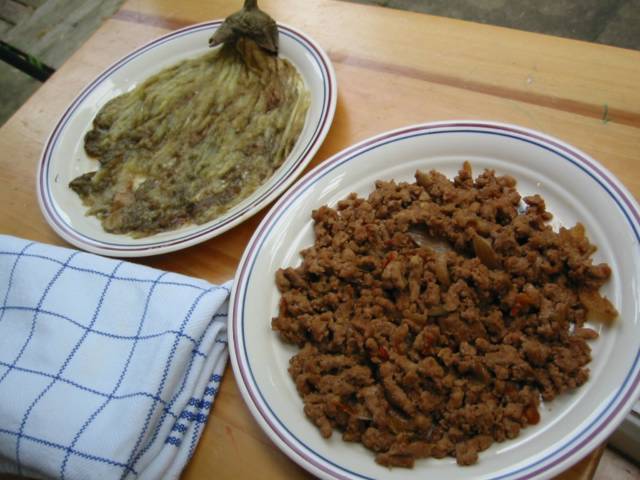
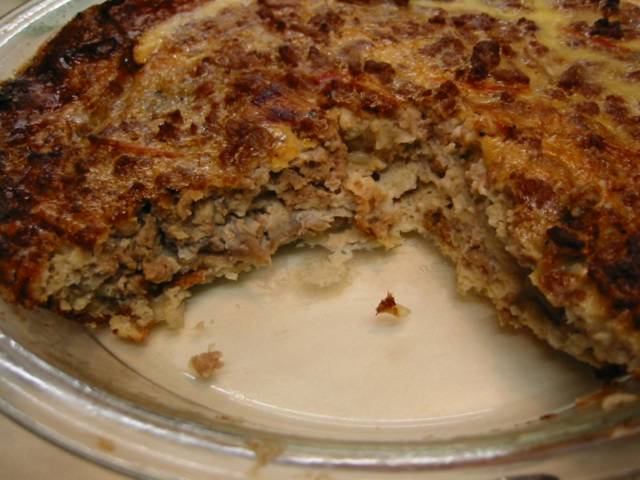
This is a very easy salad to put together and with very few ingredients as well. Often times I have this with fried anything as a foil from the grease and fat. I find it very refreshing also with roasted or barbecued meat dishes.
This is adapted from the NHK channel's Rika's Tokyo Cuisine recipe. We as a family actually enjoy watching NHK's offerings especially when it comes to their food shows. You should see us drooling, ooh-ing and aah-ing at every dish we fancy. Armchair foodies we definitely are. :)

1/4 head [about 250 g] cabbage
1/2 apple
1/4 tsp fine sea salt
1/4 tsp ground black pepper
1 Tbsp lemon juice
lemon zest (optional)
1/4 tsp sugar
2 Tbsp mayonnaise
- Finely shred the cabbage and apple (with a knife or mandolin) and put separately into different bowls.
- Add the salt and pepper into the shredded cabbage and gently work into the cabbage until it softens.
- Add the shredded apple, lemon juice, and lemon jest. Mix well.
- Combine the sugar and mayonnaise. Add to the cabbage and apple mixture and mix well to coat the veggies.
- Serve cold or room temperature.
I thought I have blogged this before and was quite surprised not to see it in the index of this blog. The current warm weather has prompted me to remember this keeper of a recipe as a great accompaniment to barbecued meats. It's very easy to assemble. Once you've done some of the simple preps all you do is toss it together. Taste.com.au has the recipe that I adapted this from.
Couscous Salad
200 g couscous
200 ml chicken stock
1 cup diced and seeded cucumber
2 tomatoes - seeded and diced
1 yellow bell pepper - seeded and diced
2 Tbsp chopped red onion
2 Tbsp chopped flat-leaf parsley
1/4 cup extra virgin olive oil
2 Tbsp lemon juice
1 Tbsp hummus (optional)
sea salt
freshly grated black pepper
- Combine the chicken stock and 1 Tbsp of olive oil in a saucepan and bring to just boiling point.
- Immediately pour over the couscous in a heatproof bowl. Cover and let steep for 10 minutes.
- Fluff couscous and season with salt and pepper. Let cool completely.
- Combine the remaining olive oil, lemon juice and hummus in a bowl and set aside.
- Toss and mix all the remaining ingredients with the couscous.
- Add the olive oil dressing and stir well to combine.
 I am massively supporting Susan's (of Food Blogga) blogging event called "Beautiful Bones" to highlight osteoporosis. This is one event that I really feel close to my heart. I do feel strongly mainly because my mother's side of the family have been blighted by osteoporosis and other bone diseases. And if me and my siblings are not careful we would be victims as well later on.
My dear old grandma, Lola Ebia, is in her 95th year. Her spine is bent forward making it difficult for her to move around. Worse off was her late older sister, Lola Ine, who was not only bent almost 90 degrees from the waist up but whose spine was shaped like a big letter S on her back. It did not seem give her that much health problems (or maybe I just didn't hear much about it) but it did present a great difficulty for her physically moving about. Me and my cousins were joking then at what shape her coffin would be when she died.
It did not end in my grandma's generation. My mother and her siblings are now beginning to feel various forms of bone diseases. And it's not confined to the women even our uncle who is very fit and follows a healthy lifestyle succumbed to some problems with his hipbone and had to be operated on when he was only 65. So me and my cousins better beware and heed the signs to take better care of ourselves or we will suffer in later years.
As what Susan mentioned in her blog, there are lots of food sources of calcium ranging from the usual dairy products to vegetables to nuts and lots of others. Bear in mind to temper the consumption of these with fibre since too much fibre restricts the absorbtion of calcium by the body. To strike a balance between consumption of calcium and fibre-rich food would be the optimum goal. As usual moderation is the key.
I have chosen to cook this dish rather than the usual dairy product sources since the soya bean in the bean curd and the green bokchoy are rich in calcium and would do well in balancing our intake of healthier food. Sorry for the limp overcooked bokchoy. Distractions while cooking can be hazardous to the final cooked products.

1 pkg bean curd (4 squares)
2 green onions - sliced into 1/2-inch pieces
6 slices ginger root
5 pieces dried Chinese black mushrooms
1/2 cup sliced bamboo shoots
3 pieces bok choy - cut into quarters lengthwise
1/2 tsp hot chilli paste
1 cup stock
2 Tbsp soy sauce
1 Tbsp oyster sauce
1 tsp sugar
1/2 Tbsp cornstarch
1 Tbsp water
oil for frying
- Soak the mushrooms in hot water for about 20 minutes or until soft. Squeeze out water then slice into 1/2-inch pieces lengthwise.
- Combine stock, soy sauce, oyster sauce and sugar in a container. Stir until sugar is dissolved. Set aside.
- Mix cornstarch and water in another bowl, stir and set aside.
- Cut the bean curd into thin triangles. Deep fry or pan fry until golden brown. Set aside.
- Heat a wok and add 2 Tbsp oil. Stir fry the green onion and ginger until aromatic.
- Add the Chinese mushrooms, chilli paste and bamboo shoots, stir to mix.
- Then add the bok choy and stir fry in high heat for a few seconds.
- Add the oyster sauce mixture and fried bean curd.
- Bring to boil and cook for 3 minutes or until the liquid has reduced to half.
- Add the cornstarch mixture and bring to boil to thicken.
- Dish up and serve immediately.
 The current theme of the 20th edition of Lasang Pinoy blogging event is called binalot or 'wrapped-up'. Mita of The Unofficial Cook, who is hosting it this time, announced this blogfest a few weeks ago.
I already knew what I was going to make and dutifully called my mother and aunt at the weekend to get the recipe right. This is my very first time to make Lumpiang Sariwa so please give me some slack if you think it looks a bit far off from the traditional.
Lumpiang Sariwa literally means 'fresh springroll'. Well it's not exactly all fresh because the filling is fully cooked although that lone leaf of raw lettuce would probably qualify it for freshness. I guess it's called 'fresh' as opposed to the usual fried lumpia. The traditional wrapper for this is the same one that you use for the fried lumpias. But in the recent years it became more crepe-like in size, taste and texture.
The recipe is a medley of my family's and my sister-in-law, Ate Eva, in Toronto. And I just remembered (it's been years since I ate one of these) as I was taking a bite that I really don't like camotes or potatoes in it. I much prefer it with just veggies and whatever meat is included. I also found the wrapper quite rich so next time I'm gonna reduce the eggs and probably add a little salt to make it more savoury. The sauce or paalat reminded me that fresh minced garlic is preferred over crispy fried ones. Well, like most first time attempt of mine these are just a few from a litany of changes I plan to make next time I make it besides the fact that I should really make the size of the lumpia smaller.

(Fresh Springrolls)
*Filling:
100 g pork belly - thinly sliced
200 g shirmps or prawns - roughly chopped
2 cups julienned sweet potatoes
3 cups shredded cabbage
2 cups shredded green beans (bitchuelas)
1 cup shredded water chestnut (apulid)
1 cup julienned carrots
1 cup bean sprouts
1/2 cup stock
2 Tbsp oyster sauce
1/2 Tbsp minced garlic
1 medium onion - sliced
1/2 tsp salt
2 Tbsp oil
- Put sliced pork in a pot and add salt and just enough water to cover it.
- Bring to a boil then simmer until all the water evaporates. As soon as it starts sizzling add the oil and fry the pork until golden brown. Set aside.
- Saute garlic and onion until the onion is translucent.
- Stir in the shrimps and cook for 2 minutes.
- Pour in the stock. Add the oyster sauce. Bring to boil.
- Add the sweet potatoes; cover and cook for 2 minutes on medium heat.
- Add the carrots, beans and water chestnuts. Cook under cover for another 2 minutes.
- Add the bean sprouts and cabbage. Cover and cook for another 2 minutes.
- Remove from heat. Cool and drain in a colander for several hours. Reserve drained liquid.
*Wrapper:
3 eggs - beaten
1 1/2 cups water
2 Tbsp melted butter
1 1/4 cups flour
- Mix eggs, water, and butter.
- Add flour and beat until smooth and lump-free.
- Gently heat a 10-inch wide non-stick pan (a crepe pan would be best). Brush it with a little butter.
- Once hot enough pour in 1/3 cup of the batter. Swirl quickly to cover the bottom of the pan completely.
- Cook on low heat until the edges start to peel off the pan. Turn over and cook for a few seconds more. Dish up and repeat.
Note: I usually put butter for the first wrapper only.
*Sauce (Paalat)
stock
1/2 cup brown sugar
2 Tbsp dark soy sauce
1 tsp salt
2 Tbsp cornstarch
3 Tbsp water
- Dissolve the cornstarch in the water. Set aside.
- Take the liquid drained from the filling and add enough stock to make up 2 cups.
- Put this in a saucepan and add brown sugar, soy sauce, and salt. Bring to boil.
- Add the cornstarch mixture and bring to boil again. Remove from heat.
*To serve:
2 Tbsp minced garlic
roughly ground roasted peanuts
fresh lettuce leaves
Lay the wrapper on a plate. Put a lettuce on top then put about 2 Tablespoonfuls of the filling. Sprinkle some ground peanuts on top.
Fold the wrapper to enclose the fillings.
Serve with the minced garlic, ground peanuts and the paalat sauce.

How did the dish go? It should have been great but either the 1 tablespoon blachan is too much or the brand I bought is especially salty. It resulted in me and the husband fishing out the strands of kangkong from the salty sauce then smothering it with lots of steamed rice. And the whole house smelling like a shrimp stink bomb exploded. That's why in the recipe below I drastically reduced the blachan to just 1 teaspoon then I'll just go from there. But it's so nice to have a veg quite different from the usual ones especially when paired with hot grilled fish. Yum!
Kangkong Blachan
350 g kangkong (ung choi, tung choi)
1 tsp blachan (belachan, shrimp paste)
2 Tbsp hibe (dried shrimps)
2 red chillies - chopped
2 cloves garlic
2 Tbsp oil
1/2 cup water
- Cut the kangkong into 3-inch lengths. Rinse well in water then drain.
- Soak the hibe in hot water for 20 minutes. Drain.
- Grind or pound the blachan, hibe, red chillies, and garlic until fine.
- Heat oil in wok and stir fry the blachan mixture for about 3 minutes.
- Turn up heat and add in the kangkong. Stir fry for about 2 minutes.
- Add the water and cook for 1 more minute.
- Serve immediately.
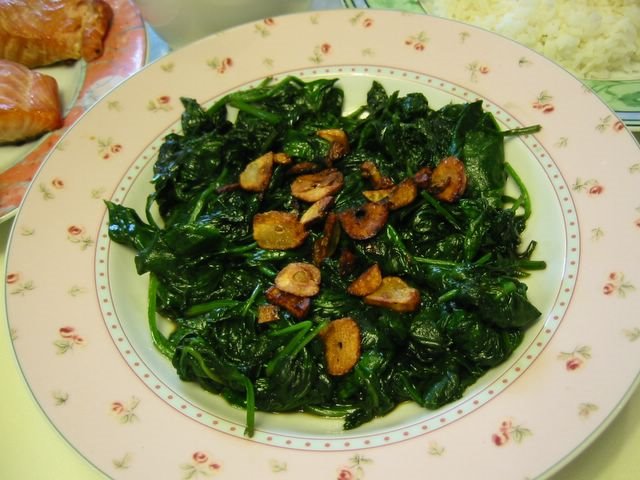
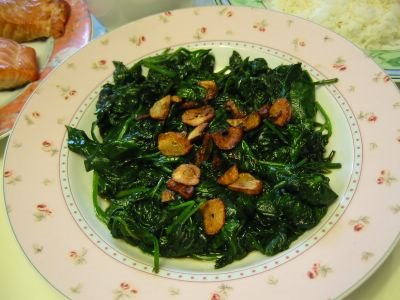 Here's one recipe that I adapted from Ken Hom's Hot Wok that I use when I have excess spinach from the usual sinigang. The other stir-fry spinach recipe that I blogged here also have garlic although it's not as fried crisp as these. I love the crunch of the garlic in contrast with the soft spinach besides the utter simplicity of the cooking and the ingredients themselves.
Spinach with Fried Garlic
Here's one recipe that I adapted from Ken Hom's Hot Wok that I use when I have excess spinach from the usual sinigang. The other stir-fry spinach recipe that I blogged here also have garlic although it's not as fried crisp as these. I love the crunch of the garlic in contrast with the soft spinach besides the utter simplicity of the cooking and the ingredients themselves.
Spinach with Fried Garlic
750 g fresh spinach - washed and drained well
1 1/2 Tbsp oil
2 Tbsp thinly sliced garlic
1 tsp sea salt
pinch of sugar
- Heat oil gently in a wok. Add in the salt and garlic. Fry on low heat until garlic is golden and crisp.
- Remove with a slotted spoon and drain on paper towels.
- Heat the oil again this time on high heat until it is smoking.
- Tip in the spinach and stir-fry for about 2 minutes.
- Add a pinch of sugar. Stir-fry for a further 3-4 minutes or until spinach is wilted.
- Remove and dish up. Scatter fried garlic on top. Serve immediately.
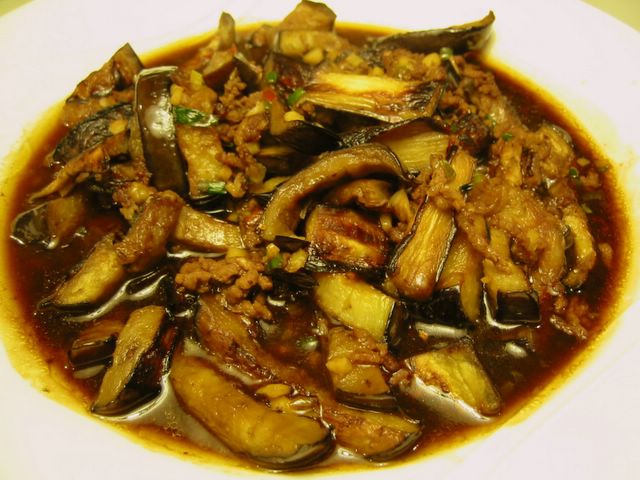
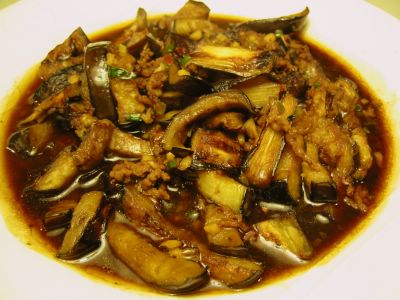 In all the cookbooks I consulted for this dish, I never found one that had fish or even fish sauce in its ingredients. So it's a mystery to me why this is described as 'fish flavoured'. Maybe someone out there knows the history? I think I read something in Deh Ta-Shiung's book on the explanation but I couldn't remember what it was.
The original recipe I adapted from the Chinese Cuisine by Huang Su-Huei requires deep frying the aubergines (eggplants). Since I know aubergines are notorious suckers of oil (they're like sponge), I decided to pan fry it in a teflon pan and drizzled with a little oil. You get the same flavour but with less oil.
Fish-flavoured Aubergine
500 g aubergine (eggplant) - sliced into 1/2-inch strips about 2-inches long
oil for frying
100 g ground pork or beef
1 tsp hot bean paste
2 Tbsp chopped green onion
1 Tbsp minced ginger root
1 Tbsp minced garlic
1 1/2 Tbsp soy sauce
3/4 cup stock
1/2 Tbsp sugar
1/2 Tbsp vinegar
1/2 tsp cooking wine
1/2 Tbsp cornstarch
1 Tbsp water
- Combine the cornstarch and water, mix well. Set aside.
- Mix the soy sauce, stock, sugar, vinegar, and cooking wine in another container. Set aside.
- Put the aubergines in a non-stick pan and drizzle a little to pan-fry until soft and cooked. Do this in batches. Set aside.
- In a wok, heat about 1 Tbsp oil until smoking hot. Stir fry the minced pork until it changes colour (about 3 minutes).
- Add in the hot bean paste, stir to mix.
- Then add the chopped green onion, garlic, and ginger. Stir fry until aromatic.
- Stir in the fried aubergines.
- Add the soy sauce mixture and cook for 1 minute.
- Thicken sauce by adding in the cornstarch mixture. Bring to boil and stir. Dish up and serve.
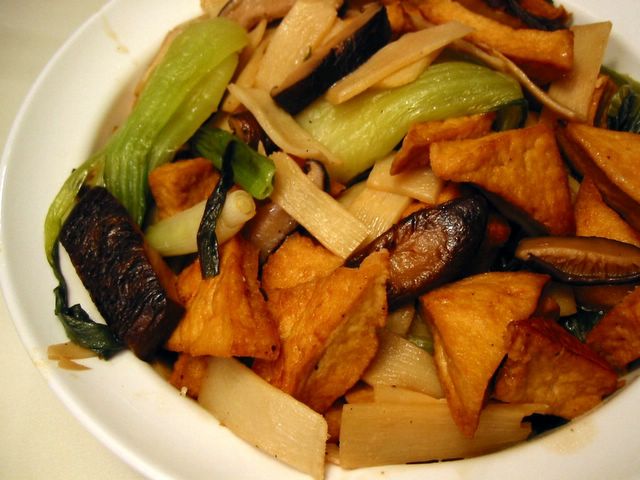
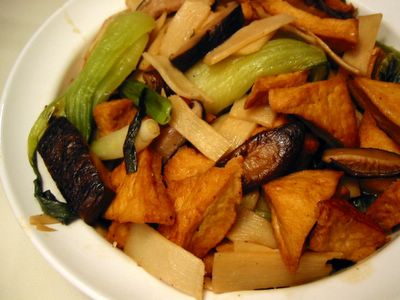 This was meant to be for the last IMBB 19 - all about vegan food. As usual, something got in the way and I was not able to post on time. But anyway, this is quite good and not far off from your usual stir fry. The only thing I don't like in it is the bamboo shoots. I've never been fond of its stinky nature so I ladled it mostly to my husband while I picked most of the bok choi and mushrooms. ;) It looks a bit dry 'coz all the sauces are at the bottom of the bowl. I should have used a shallower and wider plate just to show the sauce in all its glory. Hehe!
Oh yeah, this is adapted from the cookbook Chinese Cuisine by Huang Su-Huei.
Braised Chinese Mushrooms and Tofu
500 g firm tofu - drained and cut into bite sized pieces
2 green onions - cut into 1-inch lengths
1-inch square of fresh ginger - sliced
5 Chinese black mushrooms (shiitake)
1/2 cup sliced bamboo shoots
3 precooked bok choi (or pechay/pak choi) - sliced in quarters lengthwise
1 cup stock
2 1/2 Tbsp soy sauce
dash of ground black pepper
dash of sesame oil
1/2 Tbsp cornstarch
1 Tbsp water
oil for frying
- If using dried mushrooms, soak the mushrooms in hot water for about 30 minutes until soft. Drain and squeeze out water from them. Cut off the stems and discard. Slice into bite-sized pieces. Set aside.
- Pat tofu pieces dry and deep fry or pan fry until golden brown. Remove and drain, set aside.
- Mix stock, soy sauce, black pepper, and sesame oil in a bowl. Set aside.
- Mix cornstarch and water in a separate container. Set aside.
- Heat a wok with about 2 Tbsp oil. Saute ginger and green onion until fragrant.
- Add mushrooms and bamboo shoots. Stir to mix.
- Add stock mixture and bean curd. Bring to boil and cook for 3 minutes.
- Stir in bok choi and cook for 2 more minutes or until the liquid is reduced to half.
- Mix in the cornstarch mixture to thicken sauce. Dish up and serve.
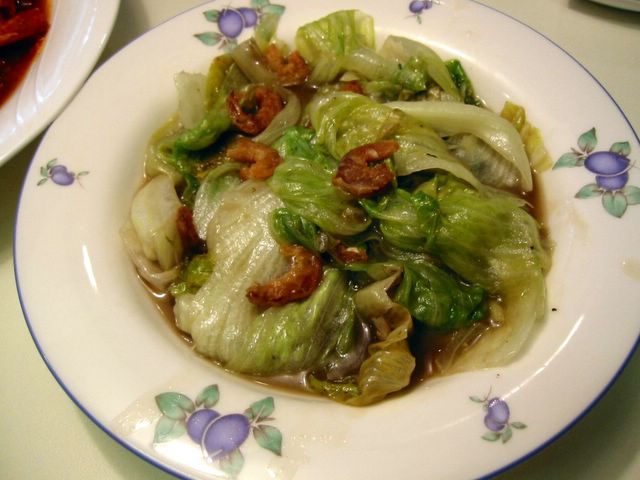
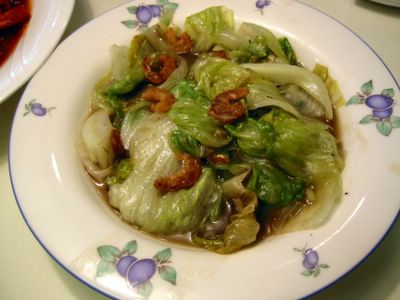 I wanted some gulay (vegetables) to go with the meat dish we have that night. But at the time our fridge was not exactly heaving with veggies in fact all we got was some leftover iceberg lettuce. I didn't want to munch on cold salad *again* so stir frying seems to be the way to go. Huang Su-Huei's Chinese Cuisine cookbook gave me the base recipe to adapt for this dish.
Stir Fried Iceberg Lettuce
I wanted some gulay (vegetables) to go with the meat dish we have that night. But at the time our fridge was not exactly heaving with veggies in fact all we got was some leftover iceberg lettuce. I didn't want to munch on cold salad *again* so stir frying seems to be the way to go. Huang Su-Huei's Chinese Cuisine cookbook gave me the base recipe to adapt for this dish.
Stir Fried Iceberg Lettuce
2 Tbsp oil
2 Tbsp dried shrimps (hibe)
1/2 tsp salt
freshly milled black pepper
1 cup stock
1 Tbsp cornstarch
1 green onion - cut into 1-inch pieces
500 g iceberg lettuce - wash and torn into large pieces
- Mix stock, salt, black pepper, cornstarch in a bowl. Set aside.
- Soak dried shrimps for 30 minutes or until soft. Drain and set aside.
- Heat oil in a wok until smoking hot. Stir fry green onions until aromatic.
- Add shrimps, cook for about half a minute; then add lettuce and cook in high heat until limp.
- Add stock mixture and cook until thick. Serve.
After what seems like a hundred years, I finally was able to cook and document a recipe of pinakbet as I promised Roh Mih. :) Pinakbet or pakbet is a melange of vegetables braised under cover traditionally in a clay pot. The northern region of Ilocos is acknowledged as its origin which is quite appropriate since a large part of the diet there is made up of veggies. As with any popular dish, there are numerous variations. One of which is that in our family we use fresh salted alamang (tiny shrimps) instead of the usual bagoong. Due to the fact that our hometown is by the seaside so there is usually an abundance of fresh seafood. Only when alamang is nowhere to be found do we use the cooked bagoong. I do have a jar of homemade bagoong sitting in my kitchen but since I found this Cincalok (fermented alamang) in our local Chinese supermarket it's but natural that I use it. I believe the Baby Rambutan has blogged about this ingredient before. Cincalok has this pungent aroma that really complemented the vegetables. Although like the bagoong it's not for everybody.
As for the veggies, any number of combination can be tipped in the pot. I banned okra since I'm not too fond of the slimy sticky texture of it. Also I did not bother to rid the amplaya with its bitterness since my husband likes them as they are. In case you want to, marinate the ampalaya in salt for 30 minutes, squeeze out juice, then rinse well with water. I almost did not include ampalaya and sitaw because of the atrocious prices. But I can't call it pinakbet with just squash and aubergine so I have to buy them with my eyes closed. :)
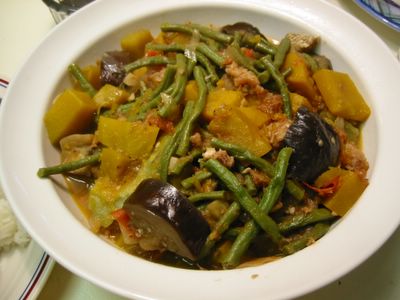 Pinakbet
1 cup diced pork belly (or any fatty piece of pork) [optional]
1 Tbsp oil
2 tsp minced garlic
1 medium onion - sliced
3 medium tomatoes - sliced
2-3 Tbsp salted alamang (tiny shrimps) or bagoong
250 g squash/pumpkin - sliced roughly into 1-inch pieces
1 medium aubergine - sliced and quarted
125 g sitaw (yard long beans, snake beans) - cut into 2-inch pieces
250 g ampalaya (bitter gourd/melon)
1 cup water
salt and pepper
- Slice ampalaya lengthwise, remove inner white membrane with a spoon and discard. Slice each half diagonally into 1/4-inch thick pieces. Set aside.
- Put pork in a clay pot or medium size pot. Pour about 1/2 cup of water on it. Bring to boil then simmer until tender adding more hot water a little at a time if needed.
- Once almost all the water has evaporated, drizzle the oil on it. Bring up heat to medium - by this time the pork will be rendering fat. Fry the pork until crispy and golden brown.
- Put to one side of the pot and spoon off excess oil. You should only have about 1-2 Tbsp oil left in the pot.
- Saute garlic and onion for a few minutes. Add in tomatoes, salt and pepper to taste. Mix in the pork and cook until tomatoes are a bit soft.
- Stir in the alamang or bagoong. Cook for a few minutes.
- Add 1/2 cup water, bring to boil.
- Add the squash, aubergine, and sitaw. Simmer under cover for 3 minutes.
- Tip in the ampalaya and cook for a further 3 minutes or until all the vegetables are cooked.
- Remove from heat and serve.
Note: If you're not going to serve immediately after cooking, leave the cover slightly ajar to let the steam out and prevent the vegs from getting overcooked or else it will lose its bite and vivid colour.
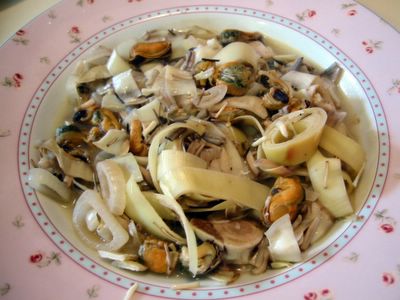 As a direct aftermath of our trip to the London Thai Food Festival, I cooked the puso ng saging or banana heart (blossom) that we bought into a kilawin. Kilawin is what we call, in the Tagalog region of the Philippines, a method of cooking with vinegar - lots of it actually.
When I was still living in the Phils. I noticed that this dish is not common in the Metro Manila area unlike in our place in Cavite where you can find it in most carinderia (eateries). Anyhow, I have to call my aunt and my Nanay because it's been more than a decade since I cooked one of these and I badly need directions. My main pet peeve was the amount of dagta (plant sap) that you have to deal with and the banana plant have a lot of it which I think it got concentrated in the heart. The soaking in water and squeezing out before putting it in the pan can only help so much. It can get really sticky. Much of it thankfully sticks on the side of the pan as you cook so you just have to spoon it off. I have to admit this recipe is still on update mode since I'm not perfectly satisfied with the result (probably because I didn't use shrimp juice) but good enough for your everyday meals.


Kilawing Puso Ng Saging
1 Tbsp oil
2 tsp minced garlic
1 small onion - sliced
1 puso ng saging (banana heart) - about 500 gm
125 g cooked shelled clams/mussels - roughly chopped or flaked canned tuna
3/4 cup vinegar
1 1/2 cup water or shrimp juice*
salt and pepper to taste
- Unwrap the banana heart (see above left) until you get to the mainly white part (see above right). Cut off the stem part and discard together with the skin that you unwrapped.
- Put 8 cups of water in a large bowl and add around 3 Tbsp salt. Make sure salt is dissolved in the water.
- Slice the banana heart into 1/2 inch thick pieces. As you slice, immediately put them in the bowl of salted water. This is to prevent them from turning black. Set aside.
- Heat oil in a saucepan. Saute garlic and onion.
- Add in the clams or mussels meat. Season with salt and pepper according to taste. Cook for about 2-3 minutes on medium heat.
- Add in vinegar and water, bring to boil.
- Drain the banana heart and squeeze out excess water.
- Stir in the the banana heart into the saucepan. Simmer until fully cooked - about 5-10 minutes.
- Remove from heat and serve.
Note: For the shrimp juice - mash heads and shells of fresh shrimps with mortar and pestle; mix well in water then strain. Discard shrimp shells.
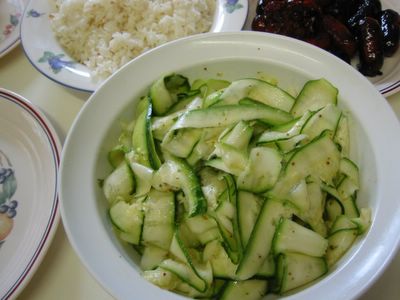 We were having longganisa with rice for lunch that day. Husband checked in the cupboard for atchara (pickled papaya) and realised we just ran out. I had to think fast on what to serve with these sausages - I need veggies that is a bit tart, refreshing and would be a foil to the sticky salty-sweet flavour of the longganisa. Immediately I remembered the carpaccio that Jeanne of Cook Sister brought to our first London blogger's EB (her original recipe is here). Fortunately, I had a couple of courgettes (zucchinis) in the fridge. It was perfect! I think this is good to serve with any grilled or barbecued meat just like what Jeanne did. Anyhow, I took the liberty of renaming the latter part of the recipe name to 'courgette' instead of the original 'zucchini' since that is how it is known around here. A very big thanks to Jeanne for sharing the recipe and I hope she doesn't mind the change in name.
Carpaccio of Courgette
We were having longganisa with rice for lunch that day. Husband checked in the cupboard for atchara (pickled papaya) and realised we just ran out. I had to think fast on what to serve with these sausages - I need veggies that is a bit tart, refreshing and would be a foil to the sticky salty-sweet flavour of the longganisa. Immediately I remembered the carpaccio that Jeanne of Cook Sister brought to our first London blogger's EB (her original recipe is here). Fortunately, I had a couple of courgettes (zucchinis) in the fridge. It was perfect! I think this is good to serve with any grilled or barbecued meat just like what Jeanne did. Anyhow, I took the liberty of renaming the latter part of the recipe name to 'courgette' instead of the original 'zucchini' since that is how it is known around here. A very big thanks to Jeanne for sharing the recipe and I hope she doesn't mind the change in name.
Carpaccio of Courgette
500 g courgettes (zucchini)
parmesan or pecorino shavings
parsley - finely chopped
*For the dressing:
1/3 cup of olive oil
3 Tbsp fresh lemon juice
1 clove garlic - crushed or finely minced
1 Tbsp capers (optional)
1 tsp wholegrain mustard
1 tsp honey
salt & milled black pepper to taste
- Wash and dry the courgettes. Using a sharp vegetable peeler, slice/shave the courgette lengthwise into ribbons.
- Mix all ingredients for the dressing together by whisking in a bowl or shaking in a jar. Pour over the courgette ribbons. Stir and mix carefully. Arrange on a platter.
- Refrigerate for an hour or two to allow the flavours to develop.
- When ready to serve, top with shavings of parmesan and sprinkle with the chopped parsley.
- Serve with good bread to mop up the dressing.
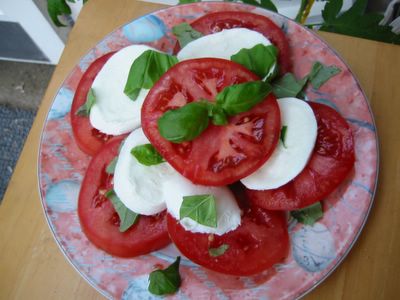
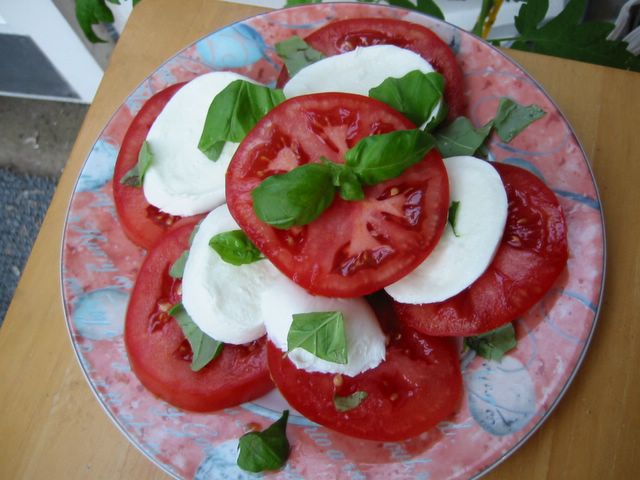
Whenever my husband wanted to have a simple uncomplicated healthy light food, the first thing that comes to his mind is this Italian salad. It is quite simply his favourite. And why not? It's one of the very few that he can make without anybody's assistance ;-). Named 'caprese' in honor of the Italian island of Capri where this supposedly originated.
There are only two main ingredients in this one - tomatoes and mozzarella cheese. As for the dressing, some people (like him) like to drizzle just olive oil and balsamic vinegar on it. Others (like me) want something with more flavour like a vinaigrette - any type will do for me. I included a vinaigrette recipe below which I adapted from Delia Smith's The Delia Collection Italian. Make sure to drizzle the olive oil or dressing right before serving because soaking in oil/dressing will just make the tomatoes soggy.We're having a lot of this lately because of the hot weather and the abundance of tomatoes in season. Beef tomatoes or large vine-ripened tomatoes can be used (though the latter has more flavour, IMO). With the cheese, get the mozzarella that's shaped like a ball and packed with some water. I heartily recommend the mozzarella made from buffalo milk (mozzarella di bufala) due it being more creamy (according to the husband) than the ones made from cow's milk.Insalata Caprese
fresh ripe tomatoes - sliced 1/4-inch thick
mozzarella cheese - sliced 1/4-inch thick
fresh basil leaves - torn into pieces
salt and pepper (optional)
olive oil and/or balsamic vinegar (optional)
*Vinaigrette Dressing
1 garlic
1 tsp sea salt
1 tsp whole grain mustard
1 Tbsp white wine vinegar
3 Tbsp extra virgin olive oil
1 Tbsp chopped herbs (basil, tarragon, thyme, etc.)
freshly ground pepper
- Arrange overlapping layers of tomatoes and mozzarella in a plate.
- Scatter the basil leaves on top and crush some salt and pepper on it, if using.
- Drizzle olive oil and balsamic vinegar or vinaigrette dressing. Serve immediately.
*For the Vinaigrette Dressing
- Mash the garlic and salt with a mortar and pestle. Add the mustard and mash until creamy.
- Transfer to a small bowl and add the vinegar, olive oil, and pepper. Whisk until thoroughly combined.
- Add the chopped herbs.
- Drizzle on salads just before serving.
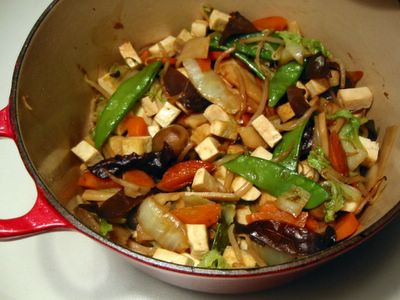
For me, after work dinner at home usually consists of some meat stew and steamed vegetables with the occassional rice. Sometimes I hanker for a more 'sophisticated' veg dish and try to whip up something quick. I almost always end up doing a Chinese stir fry because it's so easy to cook in the shortest time possible. But this dish involves braising under cover not just plain stir frying. I love the combination of the ingredients with the simplicity of the sauce it uses.
This dish is also known as 'Buddha's Delight' or Lo Han Zhai that normally uses 18 different items which I'm not sure if it represent the 18 arahats or 18 disciples. Whichever it symbolises, this Chinese dish definitely has Buddhist connections. Nowadays the use of six to eight vegetables is the more usual practice. I adapted this from the Chinese Cookery Secrets cookbook of Deh Ta Hsiung. I adore the succulent straw mushrooms but still hated the stink of bamboo shoots. Despite washing and draining it several times it still have that smell that I abhor. So probably next time I'll replace it with something else. Also the original recipe tells you to stir fry in a wok first then transfer to a casserole. I decided to do away with the wok and stir fry right in my cast iron pot which I think is okay. Also, if you have ready made seasoned oil in your cupboard you can eliminate the ginger. It's just for spicing up the oil which is entirely optional. So this is my take on the Buddha's Delight ...
Buddha's Delight
(Vegetarian Casserole)
1 cake tokwa (beancurd) - diced into 1/2-inch cubes
cooking oil for frying
2 small ginger slices (optional)
5 g [about 1 big piece] dried black fungus (wood ears)
85 g [3/4 cups] bean sprouts
115 g [about 3-4 stems] Chinese cabbage - cut into small pieces
1 small carrot - cut diagonally into thin pieces
50 g [1/2 cup] sitcharo (mangetout or snow peas) - topped and tailed
1 tsp salt
1/2 tsp soft brown sugar
85 g [1/2 cup] sliced bamboo shoots - rinsed and drained
85 g [1/2 cup] straw mushrooms - drained
1 Tbsp light soy sauce or oyster sauce
3 Tbsp stock
few drops of sesame oil
- Soak black fungus in warm water for 20 minutes, rinse and drain well. Cut into bite size pieces discarding any hard bits.
- Mix stock, soy sauce or oyster sauce in a small bowl. Set aside.
- Heat about 2-3 Tbsp oil in a non-stick pan and fry one small slice of ginger (if using) until it turns brown. Discard ginger then fry bean curds in the same oil in pan until light brown. Drain and set aside.
- Heat about 2 Tbsp oil in a casserole or medium sized pot. Again fry one small slice of ginger (if using) in the oil until the ginger turns brown. Discard ginger.
- Stir fry the Chinese leaves in the pot for about 1 minute then add the carrot, mangetout and bean sprouts with the salt and sugar. Cook for about 1 minute.
- Add the black fungus, bamboo shoots, straw mushrooms, and stock mixture. Blend well and bring to boil. Then reduce heat and cook under cover for 5 minutes.
- Lift cover and add sesame oil. Stir for a few seconds more and then serve.
Note: If you must wait for quite sometime before serving it, do not put the lid tightly on the pot. Keep it slightly ajar to prevent the vegetables from overcooking and discoloring.
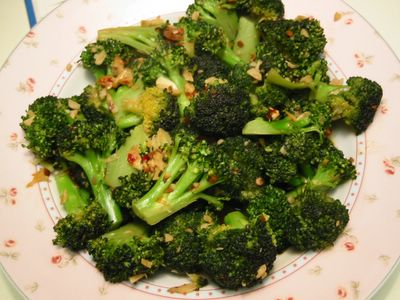
After all the sweet things I blogged earlier, it's about time I post here what I 'normally' eat. Vegetables for example. Usually I just steam them and have it with some meat - fish, pork, chicken, or beef. Other occasions when I have the time, I cook it a different way to relieve boredom or just for the heck of it, like this one. I adapted it from Ken Hom's Hot Wok cookbook. Very few ingredients, easy to make and not salty so I didn't have to reduce Ken Hom's salt ;) though I have to with the sesame oil.
It's important to blanch or steam the broccoli first to retain its firmness while stir frying and also to make sure that it gets cooked through. The plunging into cold water right after blanching/steaming is to stop the broccoli from cooking further preventing it from getting mushy later and to preserve its vibrant green colour.
Spicy Broccoli
450 g [1 lb] fresh broccoli - florets separated and stem peeled
1 Tbsp cooking oil
2 Tbsp minced garlic
1 tsp sea salt
1 tsp sugar
freshly ground black pepper
2 Tbsp cooking wine (rice wine or dry sherry)
1 Tbsp chilli bean sauce
2-3 Tbsp hot water
1 tsp sesame oil
- Mix cooking wine, sea salt, sugar, pepper in a small bowl. Set aside.
- Steam or simmer the broccoli pieces in a saucepan of boiling water for about 2-3 minutes. Drain and then plunge into a bowl of ice cold water for about 30 seconds. Drain again thoroughly.
- Heat a wok over high heat until hot. Add oil and when it is very hot and smoking, stir fry garlic and chilli bean sauce briefly.
- Add in the cooking wine mixture and broccoli. If it is getting a bit dry, add in a few tablespoon of hot water at a time. Stir fry for about 4 minutes or until broccoli is cooked through or fork tender.
- Add the sesame oil and continue to stir fry for 30 seconds. Dish up and serve.
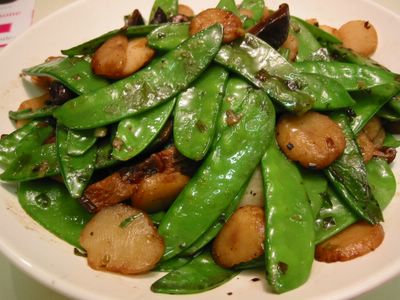
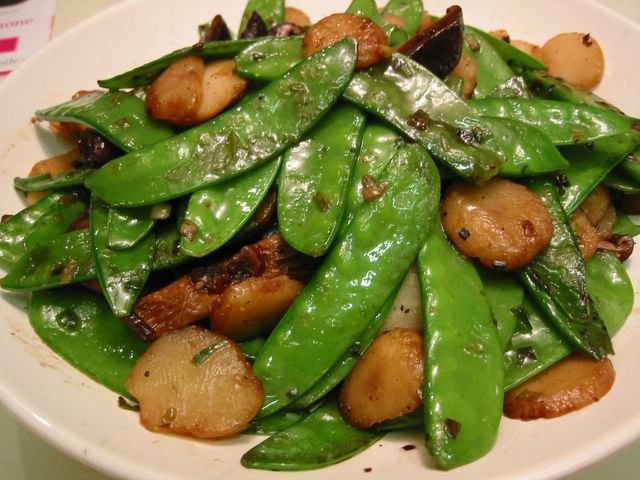
Ken Hom's combination of vegetables in his stir fries is something I've always loved. Though I do have problems with the saltiness of his dishes. More often than not I have to reduce (sometimes considerably) either the salt or soy sauce or the fish sauce to give my kidneys some respite. Other than that, his inventiveness and ability to adapt traditional Chinese recipes to contemporary ingredients and Western kitchens is never in doubt. I've often consulted his cookbooks whenever I need to have some 'imaginative' Asian dish. This one is adapted from his Hot Wok cookbook.
Stir Fried Mangetout and Water Chestnuts
(Ginisang Sitcharo at Apulid)
225 g drained canned water chestnuts (apulid)
30 g dried Chinese black mushrooms
1 Tbsp groundnut oil
3 Tbsp finely chopped green onions
225 g mangetout (snow peas/sitcharo) - trimmed
1 Tbsp rice wine or dry sherry
2 Tbsp dark soy sauce
1/2 tsp sea salt
1/4 tsp freshly ground black pepper
1 tsp sugar
3 Tbsp water
1 tsp sesame oil
- Soak the mushrooms in hot water for about 20 minutes. Drain and squeeze out the excess liquid. Cut and discard the stems and finely shred the caps into thin strips.
- Combine the soy sauce, sea salt, rice wine, pepper, sugar, and water in a bowl. Set aside.
- Heat a wok over high heat until hot. Add the oil, when it is smoking hot add the green onions and stir fry for 10 seconds.
- Add the mangetout and mushrooms. Stir fry for 1 minute.
- Add the soy sauce mixture and continue to stir fry for another 3 minutes.
- Add the water chestnuts and cook for a final 2 minutes.
- Stir in the sesame oil, dish up and serve at once.
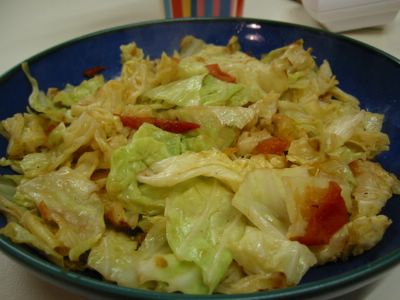
I love stir fried veggies, whether they're combination type or single veg one, they're welcome to my stomach any time (well probably not at breakfast). This dish is a singleton - featuring the irrepressible cabbage. The humble cabbage has a lot of health benefits like helping in preventing cancers (stomach, colon, breast), prevents ulcers, stimulates the immune system, etc. Although, like most anything in life I would suggest moderation in eating cabbage because it can also block the absorption of iodine by the thyroid gland which results in reduced secretion of the thyroxin hormones which in turn regulates metabolism in our body. How do I know? I have hypothyrodism (means: my thyroid is too shy to give out enough hormones) and I know from the PGH Internal Medicine team's (or whatever they were called) research of farmers in the area of Baguio, Philippines that the cause of the high incidence of hypo/hyperthyrodism in the area is because cabbage is a staple food of theirs. So I wouldn't recommend eating cabbage 3 times a day but have it once in a while maybe once a week.
Now this is sounding like a medical blog ... let's get back into the cooking fire. The only problem I had when I cooked this is that the cabbages here in UK are quite tough compared to the one in Asia. The leaves are certainly thicker and the midrib much more. So much so that I have to trim the latter out otherwise I would have to boil it first before stir frying. Double dead. That would defeat the purpose of stir frying vegs, isn't?
This is adapted from the Chinese Cooking for Beginners by Huang Su-Huei.
Stir Fried Cabbage
450 g cabbage - sliced to bite sized pieces
1 medium tomato - sliced
2 Tbsp cooking oil
3 Tbsp water
1 tsp sugar
2/3 tsp sea salt
- Combine the water, sugar and salt in a bowl. Stir to dissolve the sugar and salt.
- Heat the wok then add the oil. When the oil is smoking, add the tomato and stir fry lightly for about 30 seconds.
- Stir in the cabbage and stir fry for about 1 minute or until a bit limp.
- Add the water mixture and quickly stir fry until thoroughly mixed. Serve.

One thing about the cooking of mung beans, other people strain the mush after softening (by boiling it) mainly to separate the skin from the 'meat'. My FIL and husband couldn't care less. They eat it skin and all. But me I'd like to get as much skin out as possible but do not like the tediousness of straining it. Besides you get less of the 'meat' (will somebody please tell me what do you call the inside of a bean?) when doing the latter. As for the meat that goes with this, we usually have the pork and the tinapa (smoked fish) flakes when we were in the Philippines. Here it's harder to source the tinapa so we just make do with shrimps. You can have all 3 meats (pork, shrimp, tinapa) in there it's all up to you. Or you can just have a combination of 2, 1 or even none. Nowadays, we skip the fatty pork for health reasons. :-p
Ginisang Munggo
(Sauteed Mung Beans)
1/2 cup sliced fatty pork meat [optional]
1 Tbsp cooking oil
1/2 Tbsp minced garlic
2-3 medium tomatoes - sliced
1 medium onion - sliced
3-4 Tbsp bagoong (sauteed salted tiny shrimps)
1 cup mung beans
1 cup shelled shrimps or prawns
1/3 cup flaked tinapa (smoked fish) [optional]
2 cups spinach - washed
1 tsp sea salt or 1 Tbsp patis (fish sauce)
- [Optional] Put the mung beans in a container and add enough water to cover it. Discard all ones that float. Soak for several hours.
- Drain mung beans and put in a saucepan. Add about 4 cups water and bring to boil. Bring down heat to low and simmer until mung beans are soft and separating from its skin.
- To remove as much skin as possible without straining, make sure the boiling water level is at least 1/2 inch above the mung beans level. Bring up the heat to medium, cover and bring it up to boil. Remove cover and you can see that the skins congregate at the centre and around the sides of the pan. Once you remove the cover you have to immediately scoop out the skins. You have to catch them while they're still floating on top because upon lifting the cover the cold incoming air (or the loss of heat) makes them sink that's why you have to be quick. Cover and wait for it to boil again and repeat the exercise until you've
given up removed as much skin as you can. Remove from heat and set aside.
- [Optional] Put pork meat in a separate saucepan and add just enough water to cover it. Bring to boil and let it simmer at medium heat until water dries out. Just before it does, add the oil to make the meat render more oil and let it fry in its own fat. Do this until pork is lightly brown. Push to one side in the pan.
- Saute garlic in low heat until light brown. Then add onion, bring heat to medium and cook for about 3 minutes. Add tomatoes and cook until soft.
- Add bagoong, stir fry for about 1 minute. Add the shrimps and stir fry until pink.
- Tip in the cooked mung beans including its sauce. If it's too thick add a little hot water. Bring to boil and then lower heat to simmer for about 5-10 minutes while stirring from time to time. Taste and if need be add some sea salt or patis.
- Stir in the flaked tinapa (if using) and spinach. Simmer again briefly for about 2 minutes. Remove from heat and serve.
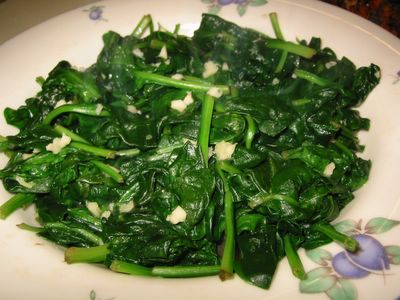
My current eating habits has made me comb through my cookbooks of recipes that I have tried and raved but eventually forgotten. Also I dug up old simple recipes that brings out the best in vegetables by virtue of the few ingredients it has. One of them is this stir fry dish from one of my favourite cookbooks Chinese Cooking For Beginners by Huang Su-Huei. It's just spinach, a little water, garlic, and salt. In place of the spinach you can substitute choi sum (Chinese flowering broccoli) or pak choi (pechay) or bok choi (green pechay) or other leafy veggies of your choice. Since the recipe is very basic, the success of this dish lies in the freshness of your spinach and the cooking method. Like in all stir frying, at the start the wok and the oil has to be smoking hot. This is to ensure that the food juices are sealed inside. It is also important not to overcook it. Cooking time of between 3 - 5 minutes is all you need if you maintain the high heat.
Stir Fried Spinach
500 g spinach
1 Tbsp minced garlic
2 Tbsp water
1 tsp sea salt
2 Tbsp oil
- Mix water, garlic, and salt in a bowl. Make sure that the salt is dissolved in the water.
- Heat oil in a wok until smoking hot.
- Put in spinach in the wok. Stir fry in high heat for about 30 seconds.
- Add in water mixture and stir fry until spinach is limp (about 2 minutes) while maintaining the high heat of the cooker hob. Dish up and serve.