We love pasta and we love meatballs, too. We already got a tried and tested spaghetti meatballs recipe but it doesn't stop us to be always on the lookout for any decent meatballs recipe out there in the world. So it's normal that we try out this much vaunted recipe from the Epicurious website that's got a very high review rating from readers. They were right! Only a few adjustments in the recipe and it's all thumbs up from the whole family. The recipe is humongous. Probably enough to feed a horde of people for a party. So I promptly halved and reduced volume and spice proportions and it scaled down well.
Spaghetti and Meatballs
*For the meatballs:
750 g minced beef
250 g minced pork
1 1/2 cups torn day-old Italian bread (or any white bread)
1 cup whole milk
1 medium onion - chopped
2 Tbsp extra-virgin olive oil
5 garlic cloves - finely chopped
3 large eggs
60 g [about 1 cup] parmesan cheese - grated
3 Tbsp finely chopped fresh flat-leaf parsley
2 Tbsp finely chopped fresh oregano (or 1/2 tsp dried)
1/2 Tbsp grated lemon zest
2 1/2 tsp fine sea salt
1/2 tsp ground black pepper
1/2 cup vegetable oil (for frying)
*For the tomato sauce:
6 x 400 g cans of chopped or plum tomatoes
1 medium onion - chopped
3 garlic cloves - finely chopped
3 Tbsp extra-virgin olive oil
2 tsp fine sea salt
1/2 tsp ground black pepper
1 kg dried spaghetti
*To make tomato sauce:
- In a large pot, heat the olive oil and cook the onions in medium heat until soft - about 5 minutes.
- Add the garlic and cook until softened - about a further 2 minutes.
- Add the rest of the ingredients, bring to a boil then lower heat and simmer uncovered stirring occasionally until thickened - about 45 minutes to 1 hour.
- Midway through cooking, you can crush the whole tomatoes with a spatula or stick blender.
*To make meatballs:
- Fry the onions in a wide frying pan on medium heat. Cook until softened while stirring occasionally - about 5 minutes.
- Add garlic and cook while stirring occasionally until fragrant and softened - about 2-3 minutes. Transfer to a bowl and cool completely.
- Soak bread in milk for about 20 minutes or until soft. Squeeze the bread firmly to remove excess milk. Discard excess milk.
- In a large bowl, combine all the ingredients except for the vegetable oil. Mix with your hands just until combined - do not overmx.
- Form into balls about 28 g (1 oz) in weight or about 1 1/2-inch in diameter.
- Heat vegetable oil in the same pan used with the onion and fry the meatballs in batches without crowding until browned all over - about 5 minutes each batch.
- Add fried meatballs into the tomato sauce and simmer for about 30 minutes.
- Cook spaghetti according to instructions in the packet.
- Serve spaghetti with meatballs and sauce with the optional grated parmesan cheese on top.
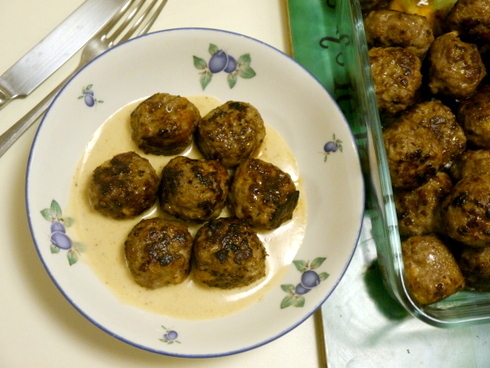
Meatballs are much appreciated in our family. Although mainly in the spaghetti meatballs type, we also like Swedish meatballs which we often buy in the local Ikea whenever we have a chance to lumber around there. But this is the first time I have created these from scratch. Really it's very similar to the other meatballs I've done before but the main difference is in the cooked chopped onions and allspice in it. Actually, the allspice is very very important otherwise you won't have that smell and taste typical to Swedish meatballs. Alton Brown provided me with a great recipe that I adapted. And although the kids didn't like the white gravy I still think all of it is great tasting. I adjusted the recipe to cater for 1 kg of meat since almost all the minced pork or beef packets sold here are in 500 g sizes.
Swedish Meatballs
2-1/2 slices of white bread (or 2/3 cup breadcrumbs)
1/3 cup milk
4 Tbsp melted butter
2/3 cup finely chopped onions
1-1/2 tsp fine sea salt + a pinch
500 g minced pork
500 g minced beef
2 large eggs
1/2 tsp black pepper
1/3 tsp ground allspice
1/4 tsp grated nutmeg
*Gravy
1/4 cup plain flour
3 cups beef stock
1/4 cup double cream
- Tear the white bread into pieces into a bowl. Add in the milk and leave to soak for about 30 minutes or until soft.
- In a 12-inch high-sided skillet, heat the 1-1/2 Tbsp of the butter and saute the minced onions. Sprinkle a pinch of the salt and cook until soft. Remove into a bowl or dish and let cool.
- Mash the soaked bread then add the rest of the ingredients. Combine until well mixed.
- Form into 1-1/4 inch balls (28 g/1 oz).
- Fry in the same skillet used for the onion using the rest of the melted butter in medium to low heat. Cook until golden brown on all sides (about 7-10 minutes). Do not crowd them too much; if need be fry in batches in which case you may have to add more butter.
- After frying, put the meatballs in a preheated 95°C/fan 75°C/200F oven to keep warm while making the gravy.
*For the gravy:
- You should have about 1 Tbsp of melted butter left in the skillet used for frying the meatballs. Decrease the heat to low and sprinkle the flour in it. Whisk until light brown - about 2 minutes.
- Add the beef stock gradually and simmer until thick.
- Stir in the double cream and cook until thick. Taste and adjust seasoning.
- Serve either covering the meatballs or on the side.
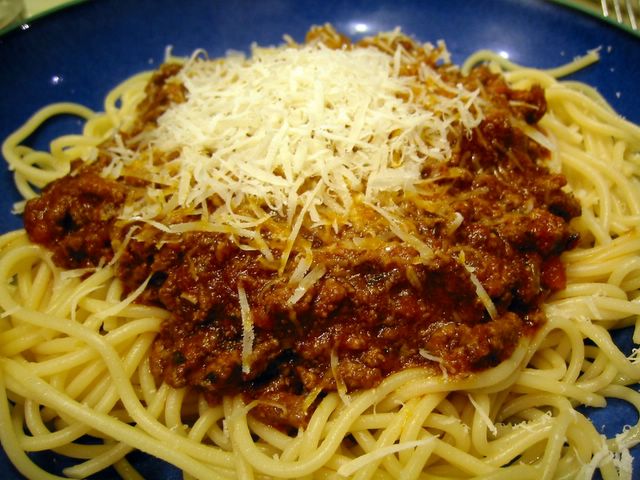
My eldest and youngest love their pasta - that's a given. It's but natural that we're looking at the many variations of the sauces that we can pair with it. Their absolute favourite is the Ragu Bolognese, aka spaghetti tomato meat sauce in this side of the Western world. The three differing sauces that we regularly use with spaghetti are: Classic Ragu Bolognese, Pinoy-style sauce, and the Meatballs sauce. This one I'm posting is quite a departure from those three. Well, it's similar to the first one but quite distinct because it does not involve any herbs, garlic nor wine! Plus the stewing technique is different and the sauce is not simmered down a thick consistency. It is kept topped up and moist. I was quite intrigued so I promptly made it a few days later. Lo and behold, the resulting sauce is really really good which even the harshest critics in the family concurring that this is a gem of a sauce.
Cooking competitions for viewers occurs from time to time in the TV magazine program The One Show in the BBC. And it's there that I chanced upon this winning recipe from a guy who in turn got it from his Italian granny-in-law. Actually she didn't give it to him, he just watched her all the time she cooks it! This happened early in 2012 and I couldn't find the permalinks anymore. Good thing I emailed the recipe to myself as soon as it was published. So who ever you are (the winner and his Italian nonna-in-law) thank you very much for sharing. Your sauce is now my kids' new pasta sauce favourite.
Tweaks I made for this recipe are - increased recipe to x1.5, changed proportion of beef to pork, and increased the passata. It's mainly to use up all the ingredients as per supermarket packaging. I really don't know what to do with a left-over 150gm of passata nor with 200gm of minced beef. Well ... I could make some other dish out of it but I couldn't be bothered to be honest, I just chucked them all in the pot which I'm sure all of you harried cooks would relate to.
So if you're the type who doesn't like herbs or the after-taste of wine in their pasta sauce this one's for you.

2 Tbsp extra virgin olive oil
500 g minced beef
400 g minced pork
3 good-quality pork sausages (97% pork) [about 200 gm]
2 Tbsp extra virgin olive oil
60 g onion - finely chopped
60 g celery - finely chopped
60 g carrots - finely chopped
500 g passata (tomato sauce/puree)
2 Tbsp double-concentrated tomato puree (tomato paste)
2 cups stock
salt and pepper to taste
- Remove sausage from casing. Mix the beef, pork, and sausage in a bowl (best to do by hand) until well combined. Set aside.
- Heat a heavy saucepan or pot. Add the olive oil in low heat and saute the onion, celery, and carrots. Cook for around 5-10 minutes or until softened.
- Add the mixed meat and brown evenly in medium-low heat. Do not overcook until dry. It must stay moist. Break up the meat with your cooking spoon as you brown it.
- Once browned, pour in the passata and tomato puree. Add the stock and stir. It should be covered by liquid.
- Season with salt and pepper. (I usually add 1 tsp sea salt at this point).
- Simmer on very low heat with the cover slightly ajar for about 4-5 hours. Taste regularly and add more salt and/or pepper if needed.
- Check the sauce regularly and if the sauce is thickening too quickly, add a little more hot water or stock. The sauce should always cover the minced meat and not allowed to dry out.
- Serve with spaghetti or any pasta shapes with a topping of freshly grated Parmesan cheese (although this is traditionally eaten with tagliatelle or rigatoni).

My former Chinese colleagues (when I was living in Hong Kong) looked in feigned disdain at me whenever I have this. "That's for tourists", they said. Well, I was a foreigner there, though not exactly a tourist, but at any rate I don't really care. LOL. Serve me sweet and sour pork with a soy sauce dip and freshly cooked rice and I'm a happy bunny. I definitely have an affinity with anything fried with sauce. Somehow the contrast of the crispiness versus whatever flavourful sauce mixed with it is quite delightful to me.
Now my main complaint with this dish is if I follow the recipe to a T, the resulting meat is not tender enough. I wonder what the Chinese restaurant chefs do to make theirs super tender? So to solve the problem I pre-cooked the pork until tender and briefly deep fry it only long enough for the outside to be crisp. It didn't seem to detract from the original intention of the recipe so I guess that's all right.
My well-worn Chinese Cooking For Beginners cookbook by Huang Su-Huei is the source of my updated recipe.
Sweet and Sour Pork
500 g pork
1 egg yolk
1/2 Tbsp soy sauce
1 Tbsp cornstarch
1/3 cup cornstarch (for dredging)
cooking oil for frying
1 small onion
1 clove garlic - finely chopped
1 cup canned pineapple chunks
1 small red or green bell pepper
*Sauce
1/4 cup sugar
3/4 cup water
3 Tbsp pineapple juice - use the juice from the canned pineapple
3 Tbsp white vinegar
3 Tbsp ketchup
1 tsp sea salt
*Thickener:
2 Tbsp water
1 Tbsp cornstarch
- Mix all the sauce ingredients in a bowl. Taste and if needed adjust to the right sweet-sour balance that suits you. Set aside.
- Dissolve the cornstarch in the water for the thickener in another container; set aside.
- Cut the pork meat into about 3/4-inch size pieces.
- Lightly tenderise the meat by pounding it with a meat mallet or with the blunt edge of a cleaver.
*OR*
Pre-cook the meat (boil or steam) until just tender.
- Combine the egg yolk, soy sauce, and the 1 Tbsp cornstarch. Mix well with the meat; set aside.
- Heat enough cooking oil in a wok for deep frying. Before frying, dredge the meat in the cornstarch.
- Once the oil is hot, deep fry the meat for about 3 minutes. If you pre-cooked the meat, deep fry for about 1-2 minutes only. Remove and drain.
- Reheat oil in wok until very hot (not smoking). Re-fry the meat for 30 seconds. Remove and drain again.
- Remove oil from wok and re-heat. In high heat, add 1 Tbsp oil and stir-fry the bell pepper. Add 1 Tbsp water and continue to stir-fry until all water has evaporated (about 30 seconds). Remove and drain.
- Re-heat wok again; add 2 Tbsp oil. Stir-fry the garlic until fragrant.
- Turn up the heat and add the onion and pineapple. Stir-fry for about 30 seconds.
- Stir in the sauce mixture and once it begins to boil add the thickener. Stir and bring to boil.
- Once thick, add the meat and bell pepper. Toss or stir lightly until sauce covers all of the meat. Dish up and serve.
*Note: Usually, I skip procedure no.9 by combining the stir-frying of the bell pepper with the onion (and omit the 1 Tbsp water). Then I add the pineapple after.
This is my homage to Hong Kong-style fastfood restaurants that ushered me gently into the wonderful world of Hong Kong food. At the start my stint in the former British colony in the early 1990s, I was quite intimidated of walking into any restaurant for fear of being reprimanded or ignored due to my lack of Cantonese language skills. So the fast food restaurants of Maxim's and Cafe de Coral were heaven sent for me. If the staff does not speak English I simply point to the brightly coloured pictures of mouth-watering food on the wall and I get served pronto!
Thank god the fast food there were so much healthier than the usual Western ones. The mains were almost always a rice-based meal or noodles with meat. Although there are some pretty weird ones like Hot Lemon Coke. Once I plucked the courage to order it to satisfy my growing curiosity. How did they do it? They filled up a tall glass with Coke, stuck in a microwave and nuked it then, just before handing it to me, dropped a slice of lemon in it. Et voila - hot lemon coke! I was laughing pretty much of the time I walked to my table. The concoction had a strange chemical potion taste to it. Similar to a medicine you're forced to swallow when you were little except it's hot. It was okay though I'm not hurrying to order another one any time soon. LOL.
Baked Pork Chop Rice is one of my favourites among Cafe de Coral's menu. It is simply fried pork chops (marinated and floured), put on a bed of egg fried rice, topped with a tomato-based sauce and grated cheese then baked. Just remembering the smell when it comes out of the oven onto my plastic tray and the wonderful taste of the succulent chops starts me drooling.
My well-thumbed Chopsticks Recipes Introduction cookbook by Cecilia J. Au Yeung is where I got the recipe that I adapted.


500 g pork chops or pork rib steaks or pork shoulder steaks
flour
grated cheddar cheese
*Marinade:
2 tsp Worcestershire sauce
1/2 tsp garlic salt
1/2 tsp celery salt (optional)
1 tsp light soy sauce
2 tsp rice wine
2 tsp sugar
1 Tbsp water
1 Tbsp cooking oil
*Sauce:
1 medium onion - chopped
2 medium tomatoes - chopped
1/2 cup of chopped vegetables - carrots, peas, sweetcorn, celery, etc.
1 Tbsp tomato paste or ketchup
1 cup stock
1 Tbsp light soy sauce
1 tsp sugar
freshly ground black pepper
1 Tbsp cornflour
3 Tbsp water
1 cooking oil
*Egg Fried Rice:
4-5 cups cooked rice (preferably chilled)
2 beaten eggs
3 Tbsp cooking oil
salt to taste
- Pound the meat with a meat mallet or the back of a cleaver knife to tenderise.
- Combine all ingredients for the marinade and mix with the meat. Marinate for 30 minutes.
- Add the oil and marinate for another 10 minutes.
- While it is marinating, make your egg fried rice. Heat the oil in a wok over medium heat.
- Add the cooked rice plus salt according to taste. If you're using chilled cooked rice, crumble the rice first before adding to the wok to separate the grains.
- Stir fry for a few minutes.
- When it is almost done, push the rice to the sides of the wok and drizzle a little oil in the middle. Pour in the beaten eggs and cook in the middle for a few seconds until almost completely set. Then combine it with the rest of the rice breaking it up as you stir it in.
- Remove from heat and set aside.
- For the sauce, heat the cooking oil over medium heat in a sauce pan.
- Saute the onion in medium heat until translucent.
- Add the tomatoes and cook until soft. Mash the tomatoes with a spatula.
- Tip in the soy sauce, sugar, tomato paste, pepper, stock, and vegetables.
- Bring to boil and then simmer until the vegetables are cooked (about 5 minutes).
- Dissolve the cornflour in the water and then add to the sauce.
- Bring to boil on medium heat and stir until thickened.
- Remove from heat and set aside.
- Dredge the marinated pork chops in flour.
- Deep fry or pan fry until golden brown - about 3-4 minutes each side.
*To assemble:
- Pre-heat oven to 220°C/fan 200°C/430°F.
- Divide the egg fried rice into oven-proof bowls.
- Top each one with one fried pork chop.
- Spoon sauce on top.
- Sprinkle grated cheese.
- Bake in oven for about 15 minutes.
- Serve while hot.

I was wondering to do different with a slab of pork belly. I could always impose an adobo on it but where's the fun in that? So a quick scan among my posse of oriental cookbooks yielded this very easy stew. The ingredients are easy to source, too. Nothing exotic nothing out of the ordinary but resulted in a very good and tasty pork stew great with steamed rice. This is adapted from the Australian Women's Weekly's Chinese Cooking Class Cookbook.
Garlic-Black Beans Pork
750 g pork belly - chopped in serving-size pieces
1 Tbsp fermented black beans - roughly chopped
1/2 Tbsp minced garlic
2 1/2 Tbsp dark soy sauce
2 tsp grated ginger
2 Tbsp oil
2 tsp cornflour
2 tsp cooking wine
2 Tbsp water
- (Optional) Heat the oil in a pot or wok and brown the pork pieces for a few minutes.
- Combine pork, black beans, garlic, ginger, and soy sauce in a pot.
- Pour enough water to cover the pork.
- Bring to boil then lower heat and simmer for about 1 hour 10 minutes or until meat is tender.
- Add a little hot water from time to time if it is drying up too much. But at the end of the cooking there should be only a little sauce left.
- Combine cornflour, wine and water. Stir into the pot and simmer until sauce thickens - about 1 minute. Remove from heat and serve.
Finally, a sweet and sour dish without the tell-tale red tinge of ketchup. This is quite a departure from the usual Chinese standard though not entirely alien to the Filipino cuisine since we have ketchup anaemic 'agridulce' sauces used as a dip or (obviously) as sauce.
Warning: don't overcook the meatballs because they will turn dry and tough once it's been sitting on your dinner table for a few minutes. That's what happened to me first time I attempted this. The red hot chilli peppers (not the band) is entirely optional while the vegetables can be varied according to your taste. Just think of the colour, texture, and taste combination when you decide on some other veggies to put in the mix. My beloved Chinese Cuisine by Huang Su-huei provided the recipe that I adapted. This is actually on the cover of the cookbook!
Sweet and Sour Meatballs
500 g minced pork or beef
1/2 tsp salt
1 Tbsp cooking wine
2 Tbsp cornstarch
1/4 cup water
1 cup mangetout/snow peas (sitcharo) - topped and tailed
1 cup button mushrooms - [the smaller the better]
1 cup sliced carrots - precooked
1 red chilli pepper - sliced
1/2 Tbsp minced garlic
*Sauce:
3 Tbsp sugar
3 Tbsp vinegar
3 Tbsp soy sauce
1/2 cup water
1/2 Tbsp cornstarch
dash of sesame oil
- Mix all the sauce ingredients in a small bowl and set aside.
- Dissolve the salt and cornstarch in water and cooking wine. Mix well with the meat and form into about 1-inch balls.
- Deep fry meatballs for about 3 minutes. Drain and set aside.
- In a wok, heat up 2 Tbsp oil. Stir fry the chilli pepper and garlic until aromatic.
- Add the snow peas and button mushrooms and stir fry for 1 minute.
- Stir in the carrots and meatballs. Cook for a few seconds.
- Add the sauce and bring to boil. Simmer for 2 minutes. Dish up and serve.

Then an email exchange with the Karen, our Kapampangan-cuisine expert food blogger, cleared the haze of mystery - it had something to do with fermentation! She said that in the old days when most people make their own tocinos they keep the salt and sugar cured pork in glass jars and let it ferment for a few days. Crucially, according to Karen, the rule of thumb in curing tocino is 5 days in the fridge or 3 days without refrigeration. Care should be taken here since as you well know there is a fine line or a short period between being fermented and getting rotten! I played around with the curing/storing time in the fridge and my current standard is 5 days minimum and 7 days max. After that the meat really goes off and you don't really want to eat stinking tocino, would you?
It's only now that I realised why people would get shop-bought tocino instead of making one themselves. In this age of TV, fast food, and instant gratification, imagine waiting for almost a week to get your homemade tocino fix! I think I'll make several batches and try to freeze it next time.
See that picture of tocino below? It is naturally reddish after the fermentation so red food colouring prevalent in commercial version is not needed. You would also avoid any artificial ingredients by avoiding the said food colouring. My proportion for the salt and sugar here is still at the tweaking stage so please adjust it to your liking as you see fit. Plus I'll be also experimenting in adding honey or pineapple juice or golden syrup or brown/muscovado sugar. I will surely keep this post updated whenever I make any progress.

1 kg pork (preferably well marbled with fat like the shoulder part)
1 Tbsp fine salt
5 Tbsp granulated sugar
- Slice the meat into about 1/4-inch thick and into serving sizes.
- Mix salt and sugar well in a bowl.
- Add the pork and mix in, making sure that it is well coated.
- Put in a covered glass container and store in the fridge for about 5 days.
- To cook:
- Put tocino in a non-stick pan and add just enough water to cover it.
- Bring to boil then bring heat down and simmer for about 30 minutes or until tender. Add hot water a little at a time if it is drying up too much.
- When the water has nearly evaporated (this should be near the end of 30 minutes), drizzle some oil on it, turn heat to very low and let it fry gently. Stir occasionally and let the meat scrape the sticky residue in the pan. Cook until golden brown.
I'm not too proud of my picture here. I'm afraid my camera's about to die on me soon. There's something about rushing to serve dinner while its still warm that intrudes in the frantic trying to capture a stick-it-in-the-plate image. Somehow it doesn't jell.
That night we were hankering for something not adobo, or with tomato sauce or with noodles. Something not Asian or Oriental. What to do? A rummage thru my magazine clippings yielded this simple recipe from the 2005 calendar of Delicious magazine.
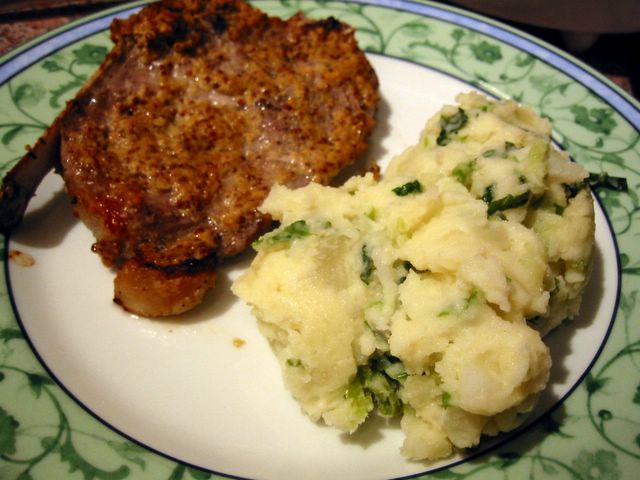
Colcannon sounds rustic at the same time complicated. When everything's revealed - tada! It's simply mashed potatoes with veggies in it! Quite a good departure from your average mash. The veggies gives it more texture, colour and health-cred. While the pork chops were simply seasoned with salt and mustard then grilled until fully cooked. Lovely!
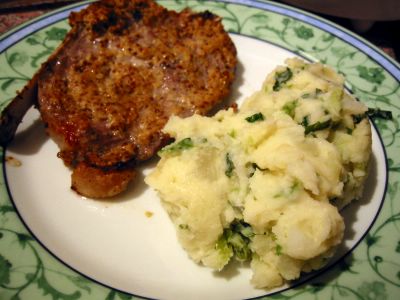 Colcannon
700 g floury potatoes (Maris Piper or King Edward)
1/4 cup butter
1/4 cup milk
1 small onion - chopped
2 springs fresh thyme - leaves picked
1/2 small savoy cabbage - shredded
- Peel and chop potatoes to even chunks. Boil in a large pan of water (or you can steam it) until tender - about 20 minutes.
- Drain and return to the pan and return to the heat for 1 minute, shaking occassionally to dry off excess moisture. If you're steaming you don't have to do this.
- Mash potatoes with half the butter and all of the milk. Season and stir until smooth and creamy.
- Meanwhile, melt the remaining butter in a saucepan and fry the onion and thyme until onion is translucent (about 5-6 minutes).
- Add the cabbage and about 1-2 Tbsp of water. Cover and cook in medium heat for about 8-10 minutes or until soft.
- Mix in cooked cabbage with the mashed potatoes. Stir until well combined.
- Keep warm until ready to serve.
Mustard Pork Chop
4 x 225 g pork loin chops
2 Tbsp wholegrain mustard
salt to taste
- Season pork chops on both sides with salt.
- Divide the mustard between the chops and spread evenly.
- Grill for 4-5 minutes each side until golden and cooked through.
- Serve pork chops with the colcannon.
 Whenever I see a hippo it always reminds me of paksiw na pata and vice versa. I wonder why? ;) Must be something to do with the folds of fatty skin and bulging roundness in its body.
Pata is the Filipino name for pork legs. Come to think of it, the word is actually Spanish. Paksiw is one of the standard traditional Filipino way of cooking dishes almost at par with the ever popular adobo probably because of its simplicity and ease of preparation. Certainly it's very similar to adobo except that the proportion of vinegar to soy sauce or salt is higher. It also uses dried banana blossoms. Now, I used to think that the ones we actually use is the dried lily buds same as the ones the Chinese use . But a check with a fellow food blogger, with my mother in the Phils, and on inspecting a packet from a Pinoy food store here, confirmed that we indeed use dried banana blossoms. It was not a fairly tale or a misnomer. Though you can definitely substitute the dried lily buds if it's not available - I can attest to that.
Like most Filipino dishes, this is best eaten with piping hot steamed rice and for me a little side dip of patis. Yum!
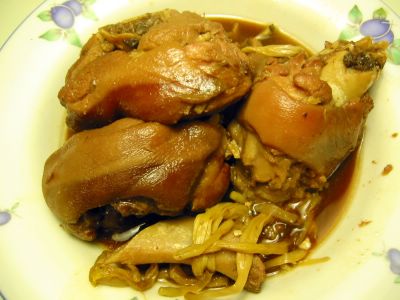 Paksiw Na Pata
1 kg bone-in pork legs - chopped into 2-inch thick pieces
1/2 cup vinegar
1/4 soy sauce
1 bay leaf
1 tsp peppercorns
1 Tbsp minced garlic
1 cup water
1-2 dried sprigs of oregano (optional)
2 Tbsp brown sugar
1/4 cup dried banana blossoms or dried lily buds
- Combine all the ingredients except the brown sugar and dried banana blossoms in a pot. Bring to boil then lower heat and simmer for 1.5 hours or until pork legs are tender. Add more hot water if it is drying out too much.
- Stir in the brown sugar and banana blossoms and simmer for a further 5 minutes.
- Serve hot with steamed rice.
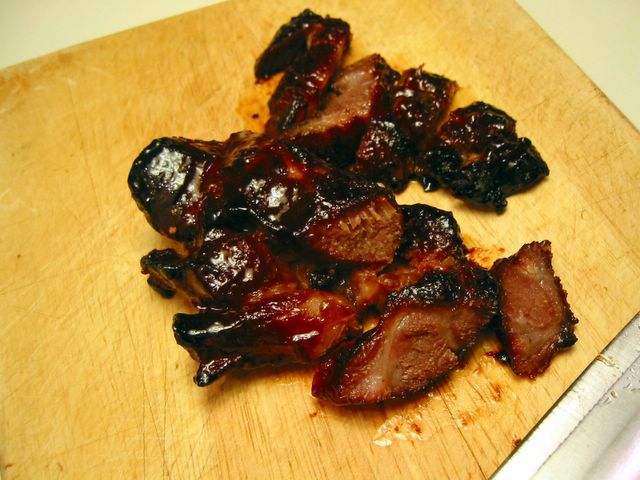
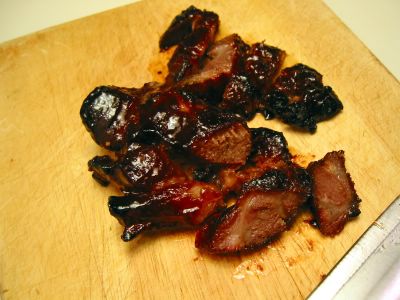 Sorry the picture isn't so pretty. Me and my husband were already quite famished when I took out of the oven. There was no time to arrange and make it pretty coz we were ready to devour it! I have several recipes of Char Siu or Cha Siu - known in English as Barbecued Pork. I intend to try them all but first I did Renee's (of the now defunct Shiokadelicious blog) recipe. Shame her formerly very popular and award-winning food blog is not online anymore. She probably is busy with some other things. Thanks very much Renee for sharing the recipe!
This is the reddish lightly charred roasted pieces of boneless pork meat hanging off a hook that you see in lots of Chinese restaurants. Very nice teamed with hot steamed rice poured with some soy sauce based sauce. Used in so many other Chinese dishes such as noodle soups, stir fried noodles, char siu pao (siopao), etc. It's quite universal and basic in Chinese cuisine or at least in the Cantonese style of cooking.
For this, I followed Renee's suggestion of using maltose. Which a type of sugar that is formed from malt usually from the production of beer. The one I got from the Chinese grocery is a very thick liquid. By the time I used it, it got cold a bit and was so very thick hence, very hard to take out of its plastic tub. I had to put it out for a time somewhere warm to soften it. Additionally, it's only mildly sweet (I tasted of course). So the resulting char siu was more on the salty side. Next time I think I'll replace some or all of it with honey just to see how the flavour will develop. But the one thing good about maltose is that it gives the char siu this nice glossy sheen that makes it look so attractive. No wonder restaurant chefs use them a lot. So maybe next time I'll keep the maltose for glazing and just increase the sugar or use honey in the marinade? Also, I did not use any red food colouring. I don't think it needs one since the Hoisin sauce already gives out the rouge it needs. Besides, I'm not too fond of artificial colouring what with all the chemicals you can find in there. I'll have to experiment on that soy sauce-based thin sauce that they pour over this on rice. My hunch is it's made from the drippings of the barbecued pork itself. If any of you have a recipe for that sauce please give me a tip. Thanks. :)
Char Siu
(Barbecued Pork)
1 kg pork (fillet, liempo, shoulder steaks, etc.)
5 Tbsp light soy sauce
3 Tbsp dark soy sauce
5 Tbsp maltose (or honey or combination of honey & maltose)
1/4 cup granulated sugar
1/4 cup rice wine (or sherry)
1/4 cup Hoisin sauce
3 pcs 1/4-inch thick slices of ginger - smashed
4 garlic cloves - kept whole and smashed
red food colour (optional)
*Glaze
2-3 Tbsp maltose (or honey) - warmed
- Mix all ingredients (except pork) in a saucepan. Heat for about 1 minute just enough to dissolve the sugar. Remove from heat and cool.
- Marinate pork in this mixture for at least overnight.
- Preheat oven to 210°C/fan 190°C/410°F.
- Remove pork from the marinade and arrange on a rack set on a roasting pan with about 1/2 inch of hot water in the pan. (This is to keep the meat moist during roasting). Bake for 15 minutes.
- Lower heat to 180°C/fan 160°C/350°F, baste the meat with its marinade and turn them over. Cook for a further 15 minutes.
- Baste again with marinade and cook for another 10 minutes. Check if meat is done.
- Remove from oven, brush with the warmed maltose (glaze) and grill for about 2-4 minutes until it's nicely browned or charred - whichever degree of finish you like.
- Serve hot or cold sliced on hot steamed rice, noodles, etc.
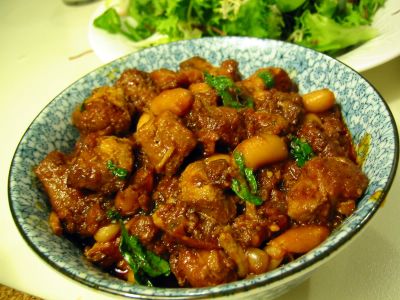 I found this in the October 2005 issue of Olive magazine. With a lot of leftover chorizo that was going to expire soon, this fitted perfectly well with what I required. Besides using up all my chorizos, this stew is quite appropriate in the current near-freezing weather sending in comfort with its rich, slightly spicy, if somewhat salty taste. You know what, this has shades of Fabada except instead of morcilla you have the chorizo. I bet this would be great as well if indeed you use morcilla. It's easy enough to cook which after you've banged up all the ingredients you just stick it in the oven and wait. Make sure to hold the seasonings first until you've tasted it since the amalgam of bacon and chorizo can be salty at times.
Chorizo and Pork Belly with Haricot Beans
I found this in the October 2005 issue of Olive magazine. With a lot of leftover chorizo that was going to expire soon, this fitted perfectly well with what I required. Besides using up all my chorizos, this stew is quite appropriate in the current near-freezing weather sending in comfort with its rich, slightly spicy, if somewhat salty taste. You know what, this has shades of Fabada except instead of morcilla you have the chorizo. I bet this would be great as well if indeed you use morcilla. It's easy enough to cook which after you've banged up all the ingredients you just stick it in the oven and wait. Make sure to hold the seasonings first until you've tasted it since the amalgam of bacon and chorizo can be salty at times.
Chorizo and Pork Belly with Haricot Beans
750 g pork belly - skin removed, cut into large chunks
130 g pancetta or streaky bacon - diced
1 large onion - chopped
1/2 Tbsp minced garlic
1 tsp hot smoked paprika
200 g chorizo - chopped
1 x 400 g can of chopped tomatoes
2/3 cup red wine
1 x 400 g can of haricot or cannellini beans - drained and rinsed
about 1/3 cup chopped fresh coriander
olive oil
salt and pepper
- Preheat oven to 160°C/fan 140°C/300°F/gas mark 3.
- Heat about 1 Tbsp olive oil in an oven proof casserole pot. Brown the pork in it at high heat. Do this in batches. Set aside.
- Reduce the heat to medium and add 1 Tbsp more olive oil in the pot and then add the pancetta. Cook for about 2-3 minutes until golden brown.
- Add in the onion and garlic and cook until softened.
- Stir in the chorizo and paprika. Cook for a minute or so.
- Put back the pork in the pot and tip in the chopped tomatoes.
- Pour in the red wine and enough water just to cover it.
- Season with pepper and cook in the oven for 2 hours.
- Remove the cover and stir in the haricot beans and return to the oven. Cook uncovered for 20-30 minutes.
- Remove from the oven and taste the sauce. If need be, season with salt.
- Stir in the coriander and serve with crusty breads or hot plain rice.
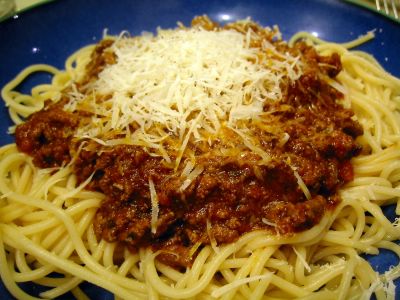 For several years now I've been trying to 'perfect' this popular Italian pasta sauce. Also called 'Spag Bol' or Spaghetti Bolognese (when served with that shape of pasta), I read in several books that Italians themselves wouldn't dream of serving this with spaghetti. They apparently use tagliatelle and after tasting this with a fresh version of that pasta, I could say I share their sentiment completely. This sauce can also be found in between lasagne sheets. Well, I've already got the Pinoy version of this plus even my son can come up with a bottled version (just brown some minced beef and pour in the bottled spaghetti sauce). But I fervently wanted to recreate the great taste of the meat sauce that we often get from Italian restaurants. This led me to looking it up in almost all the cookbooks and food magazines I come across. When I chanced upon the great collection of cookbooks in our local library, I was able to research on the authentic versions and derive a lot from it.
The word 'ragu' refers to slow cooked meat with little sauce. As with most traditional dishes there are a lot of variations even in Italy, not just from town to town but even probably from household to household. Some have all beef, have combinations of beef and pork, some use veal. Most use finely minced meat while others have diced ones. Versions also vary on whether or not to put vegetables, tomatoes, and milk or cream. The one thing that's universal in the more authentic recipes I found is the very slow and long cooking time, the use of wine (red or white), and spices. This version, which eventually met with the approval of my family, is one I culled from several cookbooks and the last one in particular from Anthony Worrall-Thompson who suggested Worcestershire sauce and anchovy sauce. It did the trick of adding a certain top note of yumminess to it. For one, my family loves its sauce very tomatoey therefore the chopped tomatoes and tomato puree are in. I also followed Delia Smith's and AWT's suggestion of browning the beef separately - it resulted in a more flavourful meat than if I did the browning right there in the stewing pot. I opted to use veggies in it because it imparts a slight sweetness, while the wine gives it body. Anyway, enough of my ramblings do try this and believe me just the aroma filling your kitchen would entice your housemates in.
Ragu alla Bolognese
1 kg minced beef (or half beef, half pork)
1 1/2 Tbsp olive oil
1 Tbsp minced garlic
2 medium onions - finely chopped
125 g pancetta or streaky bacon - finely diced
1/2 cup finely chopped carrots
1/2 cup finely chopped celery
1 Tbsp chopped fresh or 1 tsp dried thyme*
1 tsp dried oregano*
1 1/2 Tbsp chopped fresh or 1 tsp dried basil*
1/4 tsp nutmeg
1 1/2 Tbsp Worcestershire sauce
1 Tbsp anchovy sauce [optional]
1 bay leaf
1 cup white wine
2 x 400 g can of chopped tomatoes*
1/4 cup double concentrate tomato puree (tomato paste)
2 tsp sea salt (or to taste)
freshly milled black pepper
1/2 cup beef stock or water
butter or olive oil
125 g chicken liver - trimmed, washed and cut into 3/4-inch pieces
3 Tbsp single cream (light cream) [optional]
- In a pan (preferably non-stick), drizzle some olive oil and heat it up. Brown the minced beef in batches. Set aside.
- Wipe the pan and heat up some more olive oil or butter. Cook the chicken liver until well cooked and crumbly - about 5 minutes. Transfer to a bowl, then using a fork mash it up. If need be, finely chop some of the bits of liver that refuse to get mashed.
- In a big stewing pot, heat the 1 1/2 Tbsp olive oil and gently fry the bacon until it changes colour.
- Turn heat to low and add the garlic. Cook for 1 minute.
- Stir in the onion and cook gently for about 4-5 minutes or until translucent.
- Turn up the heat to medium and add the carrots and celery. Cook for about 3 minutes or until soft while stirring occassionally.
- Add the spices - basil, thyme, oregano. Stir and cook for about 1 minute or until aromatic.
- Tip in the browned minced beef and wine. Simmer until almost all the liquid has evaporated. Stir occassionally.
- Add the chopped tomatoes, concentrated tomato puree, bay leaf, nutmeg, Worcestershire sauce, anchovy sauce, chicken liver, salt, pepper, and stock.
- Bring to boil then bring down heat to lowest setting and simmer for *at least* 2-3 hours.
- If you have more fresh basil lying around, chop about 2 Tbsp of it and stir in the sauce.
- Add the cream and stir. Cook for another 1-2 minutes. Serve with freshly cooked al dente pasta such as spaghetti or tagliatelli.
*Notes:- In place of the basil, thyme, and oregano, you may use 1 Tbsp of Italian mixed herb.
- You may use 500 g passata in place of the chopped tomatoes and reduce the tomato paste to 1 Tbsp only.
Filipinos has got this great snacking culture. Our foodcentric way of life can be gleaned from the numerous times we eat in a day. In between main meals we have the proper snacks or merienda then besides these, we constantly munch on little snacks such peanuts, watermelon seeds, crispy fried corn kernels, etc. It's no wonder that there is a great proliferation of street sides snacks up and down the country. And I loved a great deal of them. From the bualaw (binatog), adobong mani, kornik, inihaw na mais, sago gulaman, to the heavier kakanin of puto, kutchinta, suman, etc. or even goto, and pancit.
I was often dissuaded by my mother from buying street side snacks because of unsanitary conditions of some vendors. Often, I sneakily buy bola-bola or fishballs dipped in that spicy semi-thick sauce. Yum! It's alright with them if I buy banana cues or valencia (turons). I think their main concern with the bola-bola is that all the customers dip in the same sauce. It can be unhealty but so far (touch wood) I haven't gone down with anything with all the copious amount I've eaten.
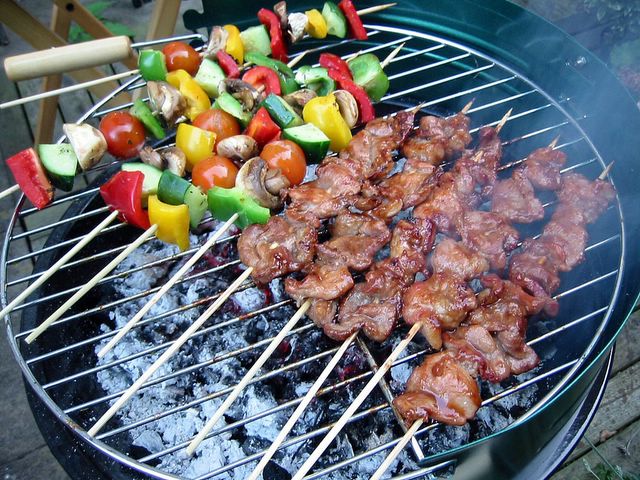
 But the one thing I simply cannot resist at the first whiff of the smoky grilling meat is pork barbecue. The thought of sinking my teeth in those slightly charred but juicy tangy-salty-sweet slivers of pork skewered in bamboo sticks with its smoky smell makes my mouth water. Ahhh, how I wish I could have one right now.
Mind you, this recipe of mine is still being tweaked. I have not found the right taste equilibrium yet that I am seeking for. So just play around with the proportions according to your taste. Actually, no matter how 'right' my recipe is, it would still not taste the same as the street side ones because you need the dust and fumes from the passing jeepneys and buses, the dirt from the street or even maybe a little sweat from the vendor (yikes) to have that authentic taste. ;) Nyahahaha!
A tip in barbecueing is to get a meat cut with some fat in it and arrange the meat a bit packed together in the skewer. These will keep it moist and juicy in the grilling. Do not grill it too well done or it will turn hard and tough. I assume you know how to start a charcoal barbecue, but just in case here it goes - wait until the charcoals have a grey ash coating (about 20-25 minutes after you start the fire) before you begin grilling. Then if your grill have graduated levels, start at a fairly high level at the beginning then lowering it as the heat dissipates or cools down.
The current host of this interesting theme of the 3rd Lasang Pinoy is Kai of Bucaio. The said blogging event were originally started by Karen and Stef as a way of showcasing the Philippine's varied food beyond the ubiquitous adobo, pancit, and lumpia plus to generally have fun in cooking and blogging about Pinoy food.
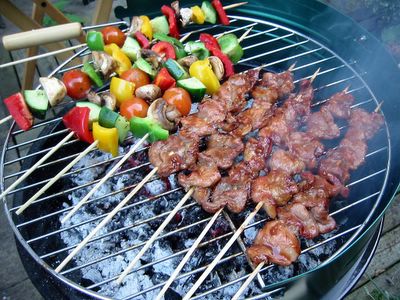 Pork Barbecue
1 kg pork meat - sliced thinly into about 1.5 square inch pieces
1/2 cup soy sauce
1/3 cup lemon juice
1/4 cup ketchup
1/4 cup honey or brown sugar
salt and pepper (to taste)
3/4 cup 7-Up
1/2 Tbsp garlic - pounded
- Mix soy sauce and lemon juice; taste it. If need be add more lemon juice or soy sauce to get the right salty-sour balance according to your taste.
- Add all the other ingredients except the pork. Taste again and adjust seasonings if desired.
- Marinate pork in this mixture overnight.
- Soak bamboo sticks in water for about 30 minutes.
- Skewer pork meat close together in the bamboo sticks.
- Bring to boil the remainder of the marinade in a saucepan. Set aside as a basting sauce.
- Grill pork barbecues over hot coals while basting with the reserved sauce.
Lasang Pinoy 3
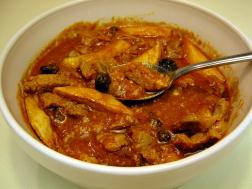
I was hoping to include this recipe of my maternal grandfather - Lolo Apeng - when I 'introduce' him in this blog. But circumstances in the other place where I blog caused me to post this to give an example of a Filipino dish that needs a boost in the presentation department. Anyhow, it tastes better than it looks - that I can assure you. The dish is something that my late grandfather came up with by combining the virtues of bistek, menudo, and afritada. Since he passed away already, nobody in my family knows why he named it Gisok. A mainstay in all of our family buffet table in Cavite, this is often requested by guests and relatives who have had it before. Our neighbors there even used to ask my lolo to prepare it for them. I hope you like this, too.
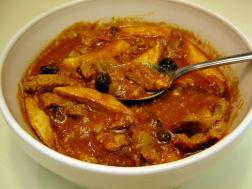 Gisok
Gisok
1 kg pork shoulder - cut into thick julienne
1 1/2 Tbsp oil
1/4 cup soy sauce
2 Tbsp lemon juice
1 Tbsp garlic - minced
1/2 cup chopped onion
1 cup chopped tomatoes
1/2 cup chopped chorizo (optional)
500 g passata (tomato sauce)
1 Tbsp soy sauce (optional)
1 Tbsp double concentrated tomato puree (tomato paste)
1/2 cup water
250 g pork or chicken liver - cut into thick julienne
salt to taste
1/2 cup grated cheddar cheese
2/3 cup raisins
500 g potatoes - julienned like French fries
- Cut the pork and liver separately into long and thin pieces about 1-2 inches long and about 1/4 - 1/2 inches wide.
- Combine the 1/4 cup soy sauce and lemon juice in a bowl. Taste and add more lemon or soy sauce according to preference. Marinate the pork in this mixture for at least 2-3 hours.
- In a large pot, heat the oil and saute the garlic, onion, then tomatoes. Add some salt.
- Add the pork including the marinade. Cook for a minute then cover the pot and simmer for about 5 minutes.
- Add the chorizo, passata, tomato puree, soy sauce (if using) and water. Bring to boil then simmer until meat is tender.
- While it's cooking, deep fry the potatoes. Set aside.
- Add the liver to the pot, cook for about 5 minutes.
- Add the raisins, cook for 3 minutes.
- Add the grated cheese and half of the potatoes. Cook for a further 2-3 minutes or until cheese is melted and well incorporated in the sauce.
- Remove from heat. Ladle into serving bowls and scatter some of the remaining potatoes on top.
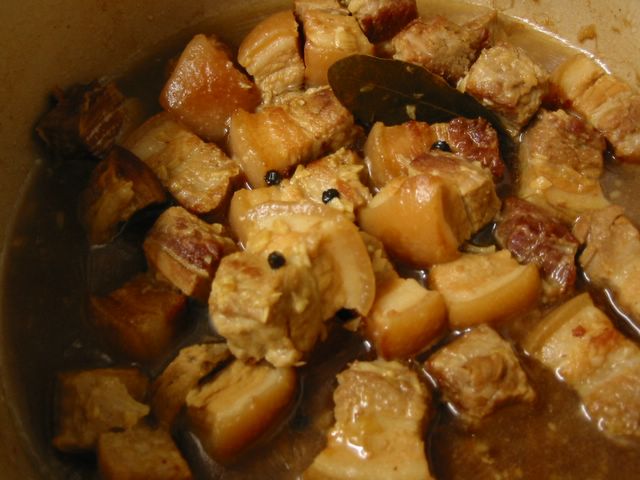
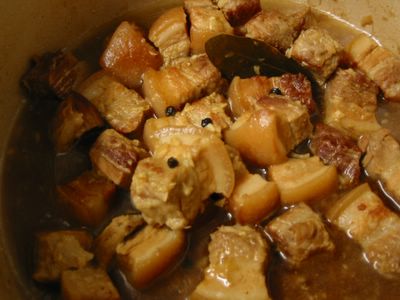 Karen must be rolling her eyes now and saying - 'Adobo na naman?!' (Adobo again?!) :LOL: I honestly don't know the official name for this adobo variation. I know the Ilocanos cook it this way but same with lots of Batanguenos. Hence, I'm not too sure of its origin as well. I took the liberty of naming it as 'blonde' since it's not as dark as the usual adobo - nothing western about it just something about the colour. When I read Reggie Aspiras' column in the Lifestyle section of the Philippine Inquirer way back in January this year, I was intrigued by her description and recipe of this soy sauce anaemic dish that I vowed that I will use my seldom-a-year quota for fatty pork on giving this a try. Normally, people just use salt though like Reggie I like patis with it. But go ahead if you want just salt to make it even 'blonder'. It's important by the way, to keep a close watch when browning the pork. Keep the heat on medium-low. You don't want the nice gravy-like sauce tasting burnt. Here is my adaptation of Reggie's recipe:
Blonde Adobo
Karen must be rolling her eyes now and saying - 'Adobo na naman?!' (Adobo again?!) :LOL: I honestly don't know the official name for this adobo variation. I know the Ilocanos cook it this way but same with lots of Batanguenos. Hence, I'm not too sure of its origin as well. I took the liberty of naming it as 'blonde' since it's not as dark as the usual adobo - nothing western about it just something about the colour. When I read Reggie Aspiras' column in the Lifestyle section of the Philippine Inquirer way back in January this year, I was intrigued by her description and recipe of this soy sauce anaemic dish that I vowed that I will use my seldom-a-year quota for fatty pork on giving this a try. Normally, people just use salt though like Reggie I like patis with it. But go ahead if you want just salt to make it even 'blonder'. It's important by the way, to keep a close watch when browning the pork. Keep the heat on medium-low. You don't want the nice gravy-like sauce tasting burnt. Here is my adaptation of Reggie's recipe:
Blonde Adobo
1 kg pork belly (or any fatty pork part) - cut into 1-inch cubes
1 head of garlic - minced (about 3 Tbsp)
1/2 cup vinegar
1 tsp whole peppercorns
1 bay leaf
1-2 Tbsp water
1 tsp sea salt
1 Tbsp patis (or another 1 tsp sea salt)
additional water
- Heat a heavy saucepan or pot. Once it's hot, rinse the pork pieces in water and drop it straight into the hot saucepan. Add 2-3 Tbsp of water.
- Simmer the meat. Soon the water would evaporate and the pork will render fat.
- Cook pork in its own fat until golden brown. Keep the heat on medium-low to avoid burning the bottom.
- [Optional] Remove excess oil leaving only about 1-1/2 Tbsp in the pot.
- Stir in the garlic, peppercorns, and bay leaf. Saute for about 30 seconds.
- Add vinegar and scrape the bottom of the saucepan. You want the brown bits at the bottom for flavour that's why it's important not to burn it.
- Add just enough water to cover the meat.
- Bring to boil again then turn heat to low and simmer until pork is tender. If the sauce is drying up too much add hot water, again just enough to cover the meat.
- Season with salt and/or patis (or if you prefer it really 'blonde' season just with salt). Taste and adjust seasoning according to taste.
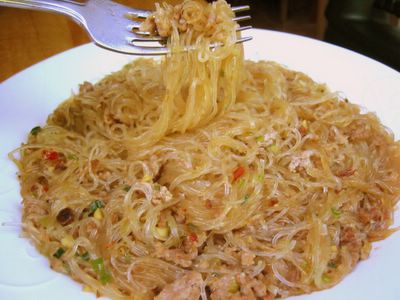
Here's one noodle dish that's so easy to make and with few ingredients. You just need some sotanghon (aka bean thread noodles or glass noodles), a little minced pork, some chilli bean sauce, soy sauce, garlic, green onion and you're done! My blogging friend Stel rightly pointed our to me that this is actually the Szechuan dish called Ants Climbing A Tree. Gosh, I didn't know that. :facepalm:
I adapted this from the Chinese Cuisine cookbook by Huang Su-Huei. Adjustments were made to the soy sauce (it was originally quite salty) and the chilli bean sauce (too hot for me) and eliminated the salt. Other than that it was easy peasy to make. Previously, I soak the sotanghon but I stopped doing that to keep it from getting overcooked since I simmer it in the stock anyway for a few minutes.
Pork Chilli Noodles
100 g sotanghon (bean thread or glass noodles)
125 g [1/2 cup] minced pork
2 Tbsp chopped green onions
1/2 Tbsp chopped ginger
1/2 Tbsp chilli bean sauce
1/2 Tbsp soy sauce
1 tsp sugar
2 cups stock
2 Tbsp cooking oil
Soak the sotanghon in water until soft (about 20-30 minutes). Drain. Cut to desired lengths.- Mix stock, soy sauce, and sugar in a bowl or container. Set aside.
- Heat oil in wok. Stir-fry pork for about 3-4 minutes. (Optional) Add about 1/3 cup hot water or stock and simmer pork until water evaporates. This is in case you want the minced pork to be tender.
- Turn up heat and add green onions, ginger, and chilli bean sauce. Stir fry for about 1 minute or until green onion and ginger becomes aromatic.
- Add stock mixture and sotanghon. Bring to boil then turn heat to low and cook for about 3-4 minutes or until the liquid has almost completely evaporated. (Optional) While cooking, cut sotanghon to desired length once soft enough.
- Dish up and serve.
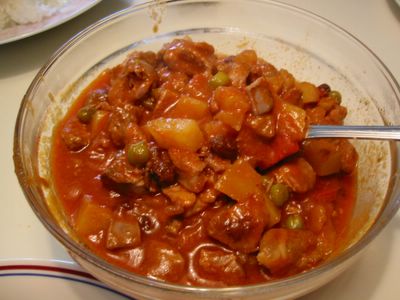
I haven't cooked menudo for a long time, actually it was years ago when I last did. This is all to do with pork liver which is a required ingredient here (if it doesn't have liver I don't consider it menudo). Pork liver in the UK really are stinky (most of the time). No matter how much I washed it before cooking, right after I stir it in the pot it starts to stink. So much so that more than half the time I have to throw away the whole lot. What a waste! I don't know why they stink here. In the Phils and in Hong Kong I never had this problem. Could it be the way pigs are raised here? Or the handling at the abbatoir? I really am clueless.
Anyway, I had some chicken liver to use up and thought of using it in menudo. It was a great addition. The taste wasn't as strong as pork liver but it will do. This recipe is how menudo is cooked in my mother's family, rich and a bit sweetish with the addition of the cheese and raisins. They are actually optional but you should at least try it with them.
Menudo
500 g pork - cut into 1/2-inch cubes
125 g chicken or pork liver - cut into 1/2-inch cubes
1 Tbsp oil
1/2 Tbsp minced garlic
1 medium onion - chopped
500 g passata (tomato sauce)
1 small red bell pepper - deseeded and cubed
2 Tbsp soy sauce
salt and pepper (to taste)
1 1/2 cup diced potatoes
1/2 cup diced carrots (optional)
1/2 cup frozen peas
1/3 cup raisins
1/3 cup grated cheddar cheese (optional)
- Heat oil in a saucepan or pot. Saute garlic and onion in low-medium heat until onion is soft and translucent.
- Stir in pork, cook for a minute. Add soy sauce, stir and cook for another minute.
- Add the passata, bell pepper, salt and pepper to taste.
- Bring to boil and then bring down the heat to low. Simmer until pork is almost cooked - about 40 minutes. If it's drying up too much add hot water a little at a time.
- Mix in the liver, potatoes, and carrots (if using). Turn up heat and cook until potatoes are almost cooked about 5 minutes.
- Add peas and raisins, cook for 2-3 minutes or until peas and potatoes are thoroughly cooked.
- [Optional] Add cheese, stir and remove from heat. Serve warm.
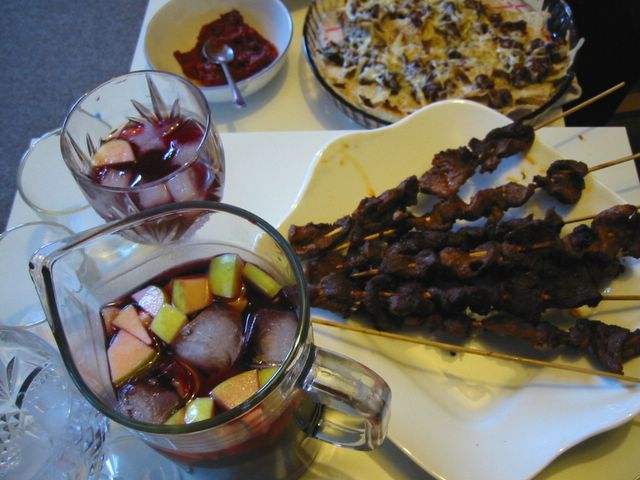
Stel of Baby Rambutan invited all bloggers for a virtual girls' night out a few weeks ago. How could one refuse? It's complete sacrilege to break my vow to party at a drop of a hat so here I am sashaying to my dance music ready to drink, eat and be merry at Stel's place. Let's parteh parteh partehhh !!
I want to sing in the karaoke so I better drink up. You know my vocal chords don't work when not lubricated by some alcoholic drink. Hic! And y'all better drink up, too. I don't want any complaints of broken ear drums when I sing. Hehehe! ;) Oh by the way, I brought these treats for us to partake ... care to join us?
Cheers mates!
![]()
I've got Sangria and some finger foods - Pinchitos Morunos and Tortilla Chilli Cheese. Actually, I also cooked Albondigas al Azafran (Meatballs with Saffron). But I think I put too much saffron and none of us really liked it. So down the bin it got chucked.

Sangria
1 bottle red wine
2 cups club soda or ginger ale
3 Tbsp sugar
1/4 cup white rum or gin (optional)
slices of unwaxed lemon and/or oranges
chopped fresh fruits (apples, pears, strawberries, pineapples, etc.)
ice cubes
- Chill red wine and club soda.
- Combine all liquid ingredients in a jug.
- Add sugar and stir until dissolved.
- Add lemon, chopped fruits, and ice cubes. Serve cold.
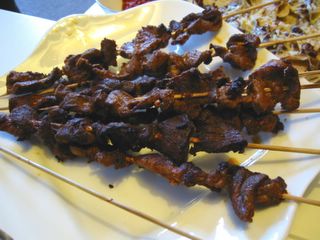
Sorry, I overcooked most of this tapas. Actually I forgot it in the oven grill. Good thing it's not completely charred. ;) In the second batch I finally got it right though it got eaten right away that's why only the burnt ones were pictured. But this was really very tasty and I'm sure the Filipino palate would like these. Adapted from Pepita Aris' Spanish Cooking cookbook.
Pinchitos Morunos
(Spicy Moorish Kebabs)
500 g pork - sliced thinly (or in small cubes - your choice)
2 garlic cloves
2 tsp sea salt
1 tsp mild curry
1/4 tsp dried thyme
1/4 tsp ground coriander seeds
1 tsp paprika
freshly ground pepper
2 Tbsp olive oil
1 Tbsp lemon juice
- Mash garlic in a mortar with the salt. Transfer in a container and mix in all the other ingredients except pork. Combine well.
- Add pork slices and mix well. Marinate for at least 2 hours or overnight.
- Skewer pork pieces in barbecue sticks.
- Grill in barbecue or oven grill. Cook in high heat for about 4 minutes each side.
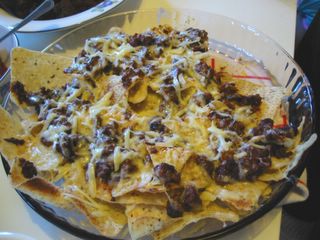
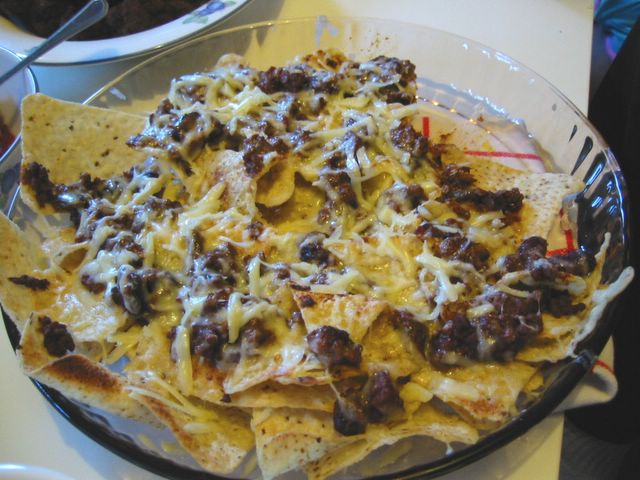
This is an appetiser I often see in Mexican or American style restaurants and often have salsa, guacamole, and sour cream instead of chilli con carne. Very easy to make that even my kids can do it.
Chilli Cheese Nachos
plain or ready salted tortilla chips
chilli con carne or salsa
grated cheddar cheese
- Put tortilla chips in a wide shallow plate or container.
- Spread evenly the chilli con carne on top.
- Sprinkle the grated cheese on top.
- Grill briefly under a hot oven grill/broiler until cheese is melted. Serve.

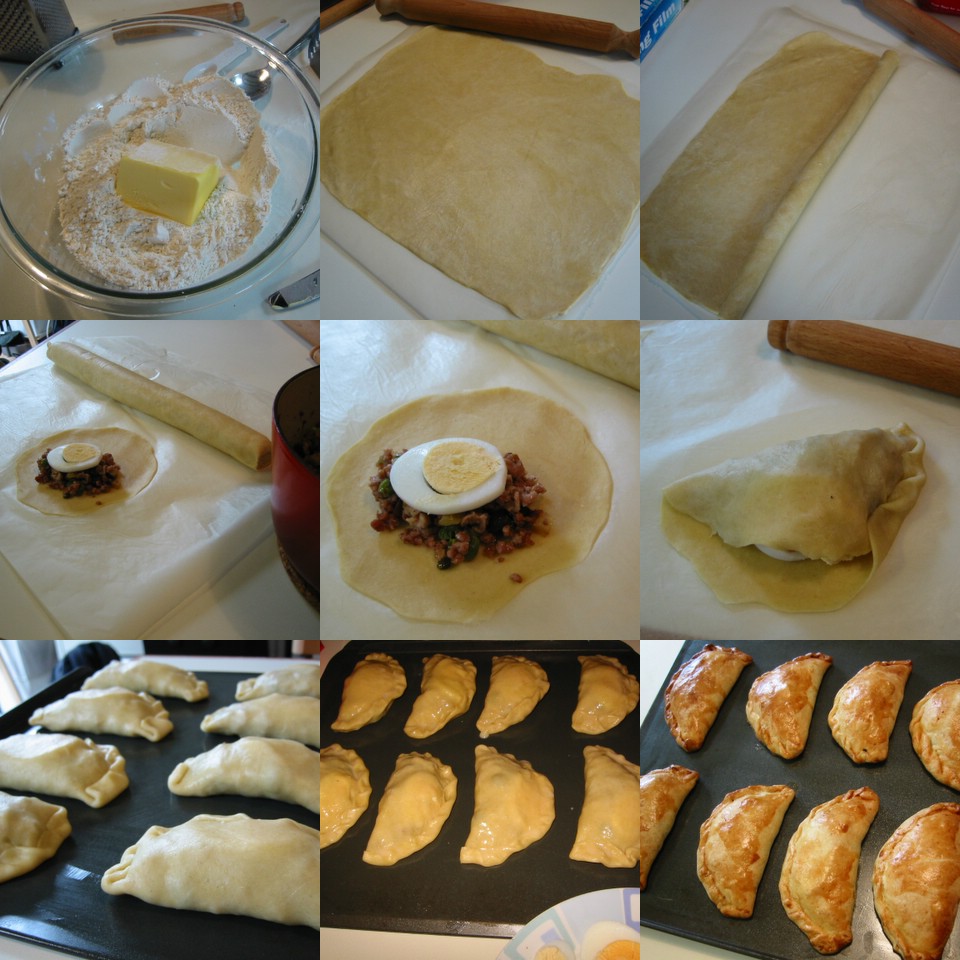
The last time I made these was about seven years ago. Too long ago that I almost forgot how to flute the edges of the pastry. Obviously this is Spanish in origin, although the Iberian version is more savoury usually with chorizos while this Filipino version is on the sweet side. Made with sweet raisins on the inside and the pastry added with some sugar.
I'd like to think these meat filled pastries are universal. Virtually every region in the world has a version of it. They vary in size and in fillings and obviously called different names but still is essentially the same 'ol thing. Called empanada in Spanish influenced countries and birdie in Scotland. Make them a bit bigger and they are called pasties in Cornwall.
I was supposed to do Stel's chicken empanada but I didn't make it to the supermarket to buy the all important asparagus soup. So I scrounged for a recipe where I had all the ingredients and found Carolina Acosta's handiwork in the Maya Cookfest 1 cookbook. Some things I have to change like omitting the hotdogs (I didn't have them) and increasing the pork and chicken. I did not precook the chicken just cooked them from raw. And as usual reduced the oil and butter. Turned out okay I thought, however, I surmised I should have stuffed more fillings in each parcel.
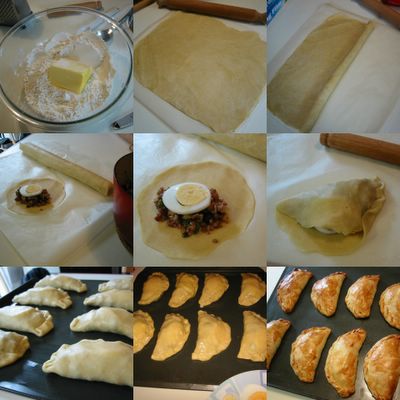
Pork-Chicken Empanada
*Filling:
1 Tbsp cooking oil
1 Tbsp butter
1 tsp minced garlic
1 medium onion - chopped
1/2 cup finely chopped bacon
1 cup minced pork
1 cup chopped chicken meat
1 cup peeled and diced potato
1 tsp Worcestershire sauce
1 tsp sugar
salt and pepper (to taste)
1/2 cup frozen peas
1/2 cup raisins - chopped
2 hardboiled eggs - sliced
chicken stock
*Pastry:
2 cups plain flour
1/2 tsp baking powder
1/2 tsp salt
2 tsp sugar
1/2 cup butter
5-6 Tbsp cold water
*For filling:
- Saute garlic and onion in oil.
- Stir in the bacon and fry for a few minutes.
- Add pork, cook in medium heat for about 15 minutes. Mash from time to time to break up meat. Add chicken stock 1-2 Tbsp at a time if the pork is getting too dry.
- Add seasonings - Worcestershire sauce, sugar, salt and pepper.
- Add chicken, cook in medium heat for a further 10 minutes or until chicken meat is opaque and cooked thru. Again add chicken stock a little at a time if it's getting too dry.
- Add potatoes, peas, and raisins. Cook until peas and potatoes are cooked through (about 5 minutes). Blend in the butter.
- Remove from heat and cool.
*For the pastry:
- Combine well the flour, baking powder, salt and sugar in a bowl.
- Cut in butter to the flour mixture with pastry cutter or two butter knives until particles are pea-sized.
- Add water a tablespoon at a time while tossing the flour mixture with a fork until all the flour is moistened and can be formed into a ball. Press the dough ball while turning a few times to incorporate all the flour in.
- Wrap in plastic cling film and chill in the fridge for 30 minutes.
*To assemble:
- Preheat oven to 200°C/fan 180°C/400°F/gas mark 6.
- Remove cling film from the dough and flatten with a rolling pin on a floured table or surface and shape into a log. (I usually use greased paper at the bottom and plastic cling film on top)
- Cut a piece and form into a ball about the size of a golf ball (1-inch in diameter).
- Flatten on the surface and roll out thinly into more or less a round shape.
- Put a heaping tablespoon of the filling mixture on the rolled out dough and top with a slice of hard-boiled egg.
- Pull one end or half of the dough over the other forming a half-circle shape.
- Seal edges by pinching by hand or with the tines of fork while cutting excess dough in the process. Repeat with the rest of the dough and fillings.
- Arrange empanadas on a lightly greased baking sheet and brush tops with egg wash (1 egg beaten with 1 tsp milk).
- Bake in oven for 20-25 minutes. Remove and serve warm or cold.
*Note: You may also deep-fry the empanadas instead of baking.