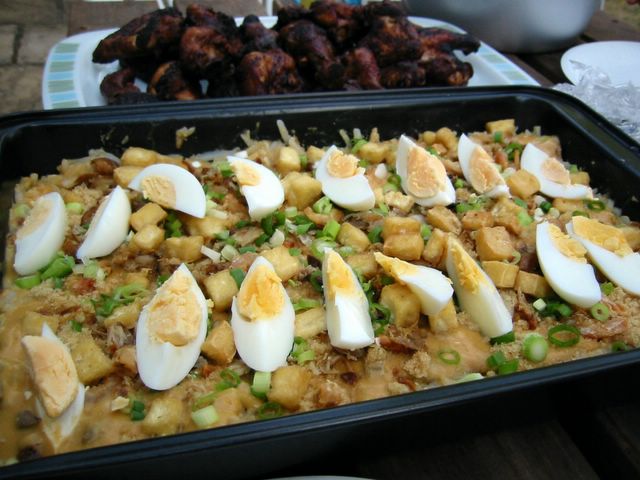
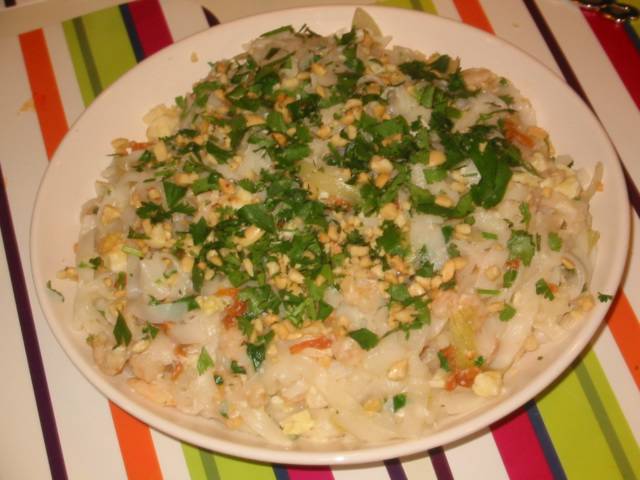
There are many variations in cooking pancit canton. You can be as elaborate as you want with cooking/blanching each vegetable to something as simple as a all-in-one cooking method. This version of mine is a happy compromise. It is very similar to what I do with pancit bihon but the main difference is in the type of noodles used. The one here is wheat-based which is certainly more flavourful than the bland rice noodle bihon. Also, liver and mushrooms are used lending difference in the filling. Do serve this with lemon juice to foil the saltiness of the sauce.
As with most of my recipes, this is a work in progress so I will be updating this from time to time.
Pancit Canton
250 g pancit canton noodles
100 g chicken meat - sliced into serving pieces
100 g chicken liver - sliced into serving pieces
50 g prawns (optional)
2 Tbsp cooking oil
2 pieces dried shiitake mushrooms
2 tsp minced garlic
1 medium onion - sliced
1/4 cup julienned carrots
1/2 cup shredded cabbage
1 1/2 cup chicken stock
1 Tbsp oyster sauce
2 tsp light soy sauce
1 Tbsp cornstarch
2 Tbsp water
salt and pepper
- Divide the garlic and onion. Soak the dried mushroom in boiling water for at least 30 minutes. Once mushroom is soft, remove stems and slice into thick strips. Set aside.
- Combine the cornstarch and 2 Tbsp water and mix well. Set aside.
- In a wok, heat 1 Tbsp of the cooking oil. Saute half of the garlic and onion.
- Add in the meats, season with salt and pepper. Cook for 2 minutes.
- Add the vegetables, saute for 30 seconds and then add about 1/4 cup water or stock. Bring to boil and simmer covered for about 3-4 minutes or until the vegetables are almost done.
Transfer to a bowl or container and set aside.
- Heat up the same wok with the rest of the cooking oil.
- Saute the rest of the garlic and onion.
- Add the chicken stock, oyster sauce, and soy sauce. Bring to boil.
- Add the cornstarch mixture and cook until thick.
- Add in the pancit canton noodles. Bring it back to boil. Lower heat and simmer until noodles are soft (about 5 minutes).
- Mix in the vegetables and meat. Stir to combine well. Dish up and serve while still hot.
 The 21st edition of Lasang Pinoy is brought to you by Bryan of Fire Water Husband (blog under renovation) who has this great idea of Cooking for Heroes. It's just as well that our current logo features the exact hero I want to cook for - Andres Bonifacio.
Even in my elementary school days I feel our dear old Andy Boni got a raw deal. I do believe he should be our national hero for he started the Katipunan, he started the ball rolling to begin the revolution and break free from the colonial masters. And what did he get for all his heroism and troubles? He got salvaged (executed) for being a rival party in the election for the head honcho of the revolutionary government. Then he lost out again almost a hundred years later in being a national hero. If that's not a raw deal I don't know what is.
It's no use arguing now about his place in history but what is undeniable is his courage, heroism, and his love of his country and fellow Filipinos. To you Andres, a big lambanog toast for being a real Pinoy! Thank you for all the things you have done for us.
What I have in mind to cook for him is something that can be considered essentially Filipino and at the same practical and nutritious for a revolutionary who had to eat on the go. And I thought why not our classic pancit. It's a complete meal in itself. It's got carbs, protein from the meat, and some wholesome veggies thrown in the process. Sounds like a good idea to me. :)
For the pancit recipe itself, this is the culmination of several years of my family's sacrifice of eating pancit as soggy and undercooked or dry and a bit tough or almost tasteless (prompting lots of toyo and lemon juice heaped on it). It took me awhile to get the hang of cooking the noodles just right. There is also the case with the oil, I used to put as little oil as possible while at the same time wondering what makes my mother's pancit well separated and really nice. Well I increased the oil exponentially with each batch - et voila! The oil is crucial! (I bet my doctor's not happy about this.) Too little will make it dry (obviously) and will tend to make it clump together. I also took my mother's advice of cooking the veggies separately to prevent it getting soggy. So like most dishes, cooking pancit successfully has a lot to do with timing. One revelation as well is that the richer your stock the better tasting your pancit will be. That my friend is guaranteed. :)
Pancit Bihon Guisado
250 g thin or medium rice noodles (bihon)
3 Tbsp oil
1 Tbsp minced garlic
1 medium onion - sliced
1/3 cup jullienned carrots
1/4 cup sliced celery (optional)
15 pieces mangetout (sitcharo)
1 cup shredded cabbage
1 cup sliced meat - chicken, pork, shrimp or combination of these*
1 1/2 cups rich stock
2 Tbsp dark soy sauce
freshly ground pepper
salt
additional stock or water
- Soak the noodles in tepid water for about 20 minutes or until soft. Using scissors, cut into desired lengths. Drain and set aside.
- In a wok, heat 1 Tbsp of the oil in medium heat. Saute half of the garlic and half of the onions.
- Add the meat and stir fry a little. Season with salt and pepper.
- Add about 1/4 cup stock or water and simmer until done. You may have to add a bit more stock from time to time to keep it from drying out.
- When the meat is done, add the carrots, mangetout, and celery. Stir to combine. There should still be some liquid in the wok if not add about 2-3 Tbsp stock and then cook under cover for 2 minutes.
- Add the cabbage, stir fry for a few seconds and cook under cover for 1 minute.
- Remove from heat and transfer to a dish. Set aside.
- Using the same wok (no need to wash unless there's some burnt crust in the bottom), heat the remaining 2 Tbsp oil on medium heat.
- Saute the remaining garlic and onion until onion is translucent.
- Tip in the stock and any sauce drained from the meat and veg mixture.
- Add the soy sauce and season with black pepper.
- Bring to boil then add the noodles. Cover and bring to boil again then lower heat to medium-low.
- Once the sauce starts getting absorbed by the noodles (about 5 minutes), toss and stir the noodles (preferably with large forks for easier tossing) until all the sauce is absorbed and the noodles are fully cooked. The tossing also make sure that the strands are separated and do not clump together. Don't worry if the bottom is getting a bit crusty. At the end there should be no sauce left but the noodles should still be moist, cooked but not soggy.
- Add half of the meat/veg mixture and toss to mix.
- Dish up and transfer to a dish. Top with the rest of the meat/veg mixture. Serve with calamansi or lemon on the side.
*Note: You may use precooked meat in which case add it in at the same time as the carrots and mangetout.
What will you do if you're far away from the Phils. and wanted to make pancit palabok with just the ingredients available in your local supermarket? That's the dilemna I had years ago when I had a hankering for a pancit palabok (aka pancit luglog) and the only Asian ingredients I can source out is the rice vermicelli and achuete (for the red colouring).
Well, most of the ingredients like garlic, green onions, pork cracklings (chicharon), and shrimps are widely available so no problem with that. For the other key ingredients like tinapa - I substituted smoked mackerel; achuete - although I had this, you can substitute it with red food colouring; calamansi - use lemon or lime or combination. The only problem is the red sauce that is at the very heart of this dish. I ran out of those ready mix packets that is so common nowadays. I didn't want to make it from scratch, i.e., pound shrimp heads, squeeze out juice, thicken with cornstarch then redden with achuete, too tedious for me. My SIL, Ate Eva, from Toronto came to my rescue saying that they've been using condensed cream of mushroom soup in place of the red sauce for ages. She was right, it was a good substitute although it's obviously on the creamy side. Trust the ingenuity of hungry Pinays to come up with the goods no matter where they are in the world. So there I have it, all the ingredients for a pancit palabok.
My next gripe would be the noodles. Or maybe lets discuss first the different names associated with this type of dish. Where I come from in Cavite, it's always called pancit luglog and almost always had the thin rice vermicelli - you know the kind that you use for the pancit guisado. The term 'luglog' would stem from the way the noodles are cooked or heated. 'Luglog' in Tagalog means 'to dip'. The tindera (vendor) would put a portion of the noodles in woven (bamboo?) elongated ladle-like tool then dip it for a few minutes in a big pot with continously boiling water or stock (for better taste). She would then put it in its eco-friendly packaging - cone-shaped wrapper of banana leaves and old newspapers. I don't know if it's peculiar to Cavite but the version there uses lots of sliced lip-puckeringly sour kalamias. I loved the the crunch and sourness it imbibes in my fav afternoon snack.
As for the pancit palabok, it was only when I moved to the suburbs of Manila that I began hearing it referred to as such. What I saw was essentially the same but for the noodles which was noticeably thicker. The word 'palabok' literally means garnish, decoration or embellishments. So it refers to the numerous things you sprinkle on top of the red sauce.
Now for the noodle gripe, I have no problem with the rice vermicelli but if you're going to serve this as a pre-mixed buffet dish it's best to use the thicker rice noodles so as to not make it too soggy while it's sitting there on the table. As of now, I haven't found a brand of thick noodles that I could say I'm satisfied with. All of the ones I tried takes about 25 minutes of boiling before it gets completely cooked. At that point it has disintegrated to 1-2 inch pieces and the water I boiled it in looked like those gawgaw mixtures my mother used to starch our clothes in! My sister told me that our aunt Ate Letty soaks her noodles first before boiling it. I did one time but still it broke up into pieces it did not hold its long strands (although it took less boiling this time.) Fortunately despite this limitation, the noodles is still completely edible though I would preferred it if the cooked strands are longer.
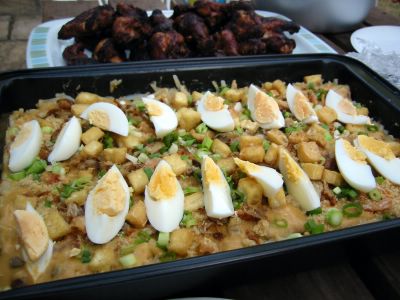 Expat's Pancit Palabok
450 g thick rice noodles
1 x 425 g can of condensed cream of mushroom soup
3 Tbsp achuete seeds (or red food colouring)
1/2 cup hot water
drop of lye water (optional)
150 g smoked fish (mackerel or haddock)
5 spring onions - chopped
1 whole head of garlic - minced
250 g of fresh shrimps or 1/2 cup of dried shrimps (hibe)
4 squares of tofu - diced (optional)
100 g of pork cracklings (chicharon) - ground/pounded
3 hard boiled eggs - quartered
lemon juice mixed with fish sauce (patis)
- Soak the rice noodles for several hours or overnight.
- Bring a potful of stock or water to boil. Drop the soaked rice noodles in it and cook until done.
- Soak the achuete in the hot water for at least 30 minutes. (Optional) Put 1 or 2 drops of lye water in it, stir to mix and soak for a few minutes more. Drain and reserve the water.
- Steam the fresh shrimps, cool, then peel them and set aside. If you're using dried shrimps - soak them in warm water for about 1 hour. Drain water and then set aside.
- Remove skin of the smoked fish and shred it. Dry fry (means no oil) or bake for a few minutes. Set aside.
- If using tofu, fry in oil until crispy. Set aside.
- Fry the minced garlic gently in oil. Drain from the oil and reserve both fried garlic and the oil used.
- Combine the cream of mushroom soup and achuete water in a saucepan. Cook gently while stirring. If the sauce is too thick add a little water at a time until it is about the consistency of yoghurt.
- To assemble buffet style:
- Mix a portion of noodles with the red sauce, some garlic, pork crackling, spring onions, shrimps, and tofu. Add some lemon juice/patis mixture to taste. Transfer to the serving dish.
- Repeat the procedure until you have filled up your serving dish. Spread a thin layer of the red sauce on top and garnish with garlic, pork crackling, spring onions, shrimps, tofu, then topped with hard boiled eggs.
- Serve lemon juice and patis on the side.
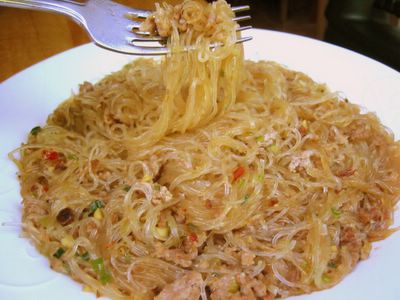
Here's one noodle dish that's so easy to make and with few ingredients. You just need some sotanghon (aka bean thread noodles or glass noodles), a little minced pork, some chilli bean sauce, soy sauce, garlic, green onion and you're done! My blogging friend Stel rightly pointed our to me that this is actually the Szechuan dish called Ants Climbing A Tree. Gosh, I didn't know that. :facepalm:
I adapted this from the Chinese Cuisine cookbook by Huang Su-Huei. Adjustments were made to the soy sauce (it was originally quite salty) and the chilli bean sauce (too hot for me) and eliminated the salt. Other than that it was easy peasy to make. Previously, I soak the sotanghon but I stopped doing that to keep it from getting overcooked since I simmer it in the stock anyway for a few minutes.
Pork Chilli Noodles
100 g sotanghon (bean thread or glass noodles)
125 g [1/2 cup] minced pork
2 Tbsp chopped green onions
1/2 Tbsp chopped ginger
1/2 Tbsp chilli bean sauce
1/2 Tbsp soy sauce
1 tsp sugar
2 cups stock
2 Tbsp cooking oil
Soak the sotanghon in water until soft (about 20-30 minutes). Drain. Cut to desired lengths.- Mix stock, soy sauce, and sugar in a bowl or container. Set aside.
- Heat oil in wok. Stir-fry pork for about 3-4 minutes. (Optional) Add about 1/3 cup hot water or stock and simmer pork until water evaporates. This is in case you want the minced pork to be tender.
- Turn up heat and add green onions, ginger, and chilli bean sauce. Stir fry for about 1 minute or until green onion and ginger becomes aromatic.
- Add stock mixture and sotanghon. Bring to boil then turn heat to low and cook for about 3-4 minutes or until the liquid has almost completely evaporated. (Optional) While cooking, cut sotanghon to desired length once soft enough.
- Dish up and serve.
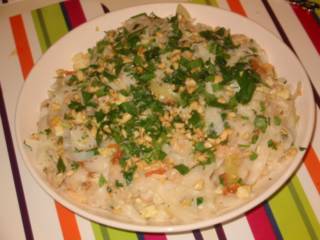 Ever since I had proper Pad Thai at a nice restaurant I've been looking for a good recipe. I came across one in Delia Smith's How To Cook book. It was good although it didn't have any sugar or sweetness in it which was strange. Anyhow, me and the hubby liked it very much we did not mind the lack of it. A Thai acquaintance told me that Pad Thai without sugar is called "Char Kuey Thieow". Meanwhile I'm still on the lookout for that ultimate Pad Thai recipe.
Almost Pad Thai
Ever since I had proper Pad Thai at a nice restaurant I've been looking for a good recipe. I came across one in Delia Smith's How To Cook book. It was good although it didn't have any sugar or sweetness in it which was strange. Anyhow, me and the hubby liked it very much we did not mind the lack of it. A Thai acquaintance told me that Pad Thai without sugar is called "Char Kuey Thieow". Meanwhile I'm still on the lookout for that ultimate Pad Thai recipe.
Almost Pad Thai
150 gm flat rice noodles (ho-fan)
2 Tbsp oil
1 tsp minced garlic
1 medium onion - sliced
1 red chilli - deseeded and finely chopped (or 1/4 tsp dried chilli flakes)
2 Tbsp dried small shrimps (hi-be)
175 gm shrimps or prawns
2 eggs - beaten
2-3 Tbsp fish sauce (patis)
juice of 1 lime - about 2 Tbsp
2 green onions - finely chopped
3 Tbsp fresh coriander - chopped
3 Tbsp peanuts - coarsely chopped/crushed
- Pour boiling water over the rice noodles in a bowl and soak for about 10 minutes or until noodles is almost cooked and tender to the bite. Drain and set aside.
- Soak dried shrimps in hot water for 10 minutes, drain, set aside.
- Mix lime juice and fish sauce in a small bowl. Mix coriander, green onions and peanuts in a container.
- Heat a little oil in wok and fry half of beaten egg (as an omelette). Remove from wok and slice into small pieces.
- Heat the 2 Tbsp oil in wok and saute garlic and onion until translucent. Add chilli, stir fry for half a minute.
- Put in dried shrimps, cook for about a minute.
- Add fresh shrimps, cook until it turns pink (around 3 minutes).
- Add lime juice and fish sauce mixture. Bring to boil.
- Add noodles and mix until noodles has almost absorbed the sauce.
- Push noodles to the side of the wok and make a well in the middle. Pour the rest of the egg in the well. Let the egg cook a little and then mix in with the noodles.
- Sprinkle about half of the coriander, green onion and peanut mix in the wok. Stir and mix for about 30 seconds.
- Transfer into a serving plate and sprinkle more of the coriander mix on top before serving.
Enjoy!