Oeufs à la neige or Snow Eggs is a favourite of my husband. Whenever we were in France and it's on the menu he often orders it. My cooking/baking to do list had this for a long time. At last this challenge from the Daring Cooks finally forced me to confront this intimidating recipe.
And challenged indeed I was. I halved the recipe since this was an experiment I didn't want to waste too much if anything goes wrong. The meringue was easy enough to do with the help of my hand mixer. But the poaching was something else. I had to emphasize in the recipe that the poaching liquid should be barely simmering. Mine seemed like it was quite hot because the meringues were getting overcooked into shriveled white things. So the poaching time was done very quickly more like 30-45 seconds instead of 2 minutes per side. Also, when you shape the meringues, make sure to use *big* spoons not like the dessert spoons I used. Because they do shrink in size a little after poaching.
Then the caramelised almond slivers came into play. Well I did it all right (although it was a little on the dark caramel side) and set it out in the dining table to cool. By the time I was to sprinkle it on the snow eggs almost all of it was gone! The husband and kids discovered them! Oh well, there was just enough bits I scraped to put as topping.
What of the dessert? How did it go? I was quite eggy, as my daughter said. Well that is a given! For me and the husband, it was very nice although the custard was a bit too sweet for me. I made the adjustments in the recipe below. Other than that I heartily recommend it. Next time I would make the presentation better such as put it in nicer bowls and opt for caramel syrup as well.
The main recipe was adapted from The Encyclopedia of Classic French Pastries by Susan Whatley and the almond praline fron Rachel Khoo's recipe of Floating Island.

(Snow Eggs)
*For the praline:
1/2 cup granulated sugar
2 Tbsp water
1/2 cup slivered almonds
- Line a baking tray with baking paper.
- Put sugar and water in a heavy bottomed saucepan and bring to a boil.
- Add the slivered almonds to the boiling syrup and keep stirring continuously.
- The sugar will being melting again and will take on a golden colour.
- Once it turns golden, pour out onto the prepared baking tray and quickly spread as thinly as possible (they set fast). Leave to cool completely.
*For the meringue:
3 large egg whites
5 Tbsp granulated sugar
pinch of salt
1 3/4 cup whole milk
- Put the egg whites in a mixing bowl with the pinch of salt. Beat with an electric hand or stand mixer on medium speed until soft peaks form.
- Increase the speed to high and add the sugar gradually while beating until all the sugar has been added.
- Beat until stiff peaks form (you should be able to hold the bowl of beaten egg whites upside down without any spilling out).
- While you are beating the egg whites, bring the milk on saucepan to a gentle simmer. Lower heat futher until there are only little bubbles at the edges.
- Using 2 big dinner spoons, form the meringue into oval shapes. Carefully drop the oval meringues into the simmering milk and poach for about 1-2 minutes each side or until puffed up and set.
- Remove from the milk with a slotted spoon and place on a sheet of tea towels or paper towels. Cool and store in the fridge tightly covered until needed.
*For the creme anglaise:
3 egg yolks
1/4 cup sugar
1/4 tsp vanilla
pinch of salt
remaining milk from poaching the meringue
- Combine the egg yolks, vanilla and sugar in a heat-resistant bowl with a whisk. Gently pour a little at a time of the still warm poaching milk on to the mixture while constantly stirring.
- Return the egg-milk mixture to the poaching saucepan and cook at low heat while constantly stirring. There should be about a little less than 2 cups of the mixture. If not, top up with more milk up to roughly that amount.
- Cook gently (do not stop stirring) until the mixture thickens to the consistency of a single cream. It should coat the back of a spoon.
- Strain the sauce and cool in the fridge covered until thoroughly chilled.
*For the caramel sauce (optional):
1/2 cup granulated sugar
2 Tbsp water
- Prepare a bowl full of tap water (preferably in a sink). The bowl should be bigger than the saucepan to be used for cooking. Set aside.
- Put the sugar and water in a heavy bottomed saucepan. Bring to boil.
- Continue boiling until it becomes golden coloured. Lower heat and cook until it is of the shade of golden colour desired. Immediately put the bottom of the pan into the bowl full of tap water to stop the caramel from cooking further.
- Use the caramel immediately
*To assemble:
- Put about 1/3 - 1/2 cup of creme anglaise in a small serving cup or bowl. Place two or three meringues on top and decorate with almond praline and/or caramel sauce.
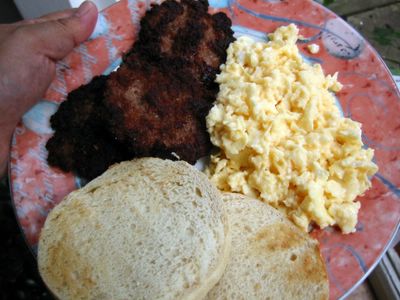 Sorry 'bout that nuked piece of sausage patty. It was supposed to be an imitation of Sausage Mcmuffin - sausage patty, English muffins, and eggs. But we got so excited I promptly forgot to lower the heat in frying the patty. Anyways, this for the record, is for my kids to remind them on how to do scrambled eggs. Funny, the thing we call scrambled eggs when I was small is actually called omelette here. Something must have been lost in translation. ;)
The key for scrambling eggs successfully is patience. You have to constantly tease, push and prod, back and forth the eggs on low heat to achieve the fluffy, soft, creaminess that is a scrambled egg. Some (my son) likes it a little bit well done. Some (my husband) loves it runny. However you like it finished, you have to start it the same way - beaten eggs cooked slowly on low heat until at a point of equilibrium it starts to curdle and form that sort of 'bubbly' texture. For me, the best way of doing this is by using a wooden fork with the tines scratching the newly formed film of cooked eggs at the bottom. A lot of cookbooks use just beaten eggs but we do like to put a little bit of milk for that extra creaminess.Scrambled Eggs
2 eggs
1 Tbsp milk
1/2 Tbsp butter
freshly milled salt and pepper (optional)
- Beat eggs with the milk in a bowl. Add salt and pepper if desired.
- Heat butter gently a heavy-bottomed saucepan or frying pan (preferably non-stick) until melted.
- Still on low heat, pour the beaten eggs in the pan.
- Stir with a wooden spatula or fork, pushing back and forth making sure the spatula is scraping the bottom. Do this until the eggs starts to solidify - about 3-5 minutes.
- If you want your eggs runny, take it out of the pan while the eggs still soft and moist and there is only a little liquid left. If you want it firm, cook further until there is no more liquid and the eggs thoroughly cooked.
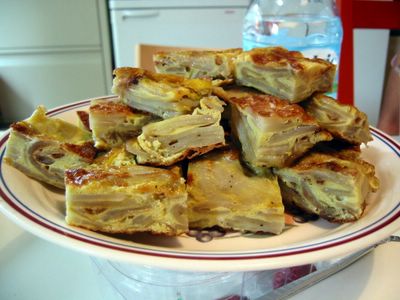 Spanish omelette, a mainstay of tapas bars, also comes in the monickers of - Tortilla Espanola or Tortilla de Patata. It's amazing that the lovely simple dish of Spanish origin (obviously!) made up mainly of only potatoes, onion, and eggs can be such a good comfort food. You can enjoy this either warm or cold so it's good for barbecues and picnics.
My mother used to cook this all the time though her version has the potatoes cubed while here its sliced very thinly. If you've got a mandolin slicer, slicing the potatoes would be a doddle just watch out for those fingers. And make sure to season it well with salt (sea salt has always been my choice). I consulted several sources for this recipe to come up with my own. Most of them uses a lot of oil, even though it's olive oil I tend to shy away from too much greasiness. Some have, in my opinion, too much eggs. I'd rather have a more 'equal' balance of potatoes and eggs in my omelette.
Spanish Omelette
500 g waxy potatoes (Charlotte, Desiree, Jersey Royals) - peeled and sliced very thinly
1 medium onion - sliced
6 eggs - beaten and seasoned with salt and pepper
salt and pepper
olive oil
- In a 23cm (9-inch) frying pan (preferably non-stick), heat about 2 Tbsp. olive oil.
- Once hot, tip in the onions then the potatoes. Season well with salt and pepper. Stir a little to mix with the oil. Lower down heat, cover, and cook for about 10-15 minutes stirring to turn carefully midway through.
- Remove potatoes and onions from the pan with a slotted spoon and drain on paper towels for about 30 seconds or just long enough to remove excess oil.
- Mix the potatoes and onions with the beaten eggs making sure it seeps in between the layers of potatoes.
- Remove excess oil from the same pan leaving just enough to coat the bottom. Heat again with hob on high.
- Put the egg and potato mixture into the hot pan and continue to cook for 2 minutes. Lower down the heat to the lowest setting and leave to cook for about 20 minutes.
- After this, there would be very little liquid left on top. Loosen the edges and bottom of the omelette. Cover with a plate larger than the frying pan. With one hand on the plate and the other on the pan handle, quickly flip the omelette onto the plate.
- Heat up the pan again with a little olive oil. Once hot, slide in the omelette back to the pan uncooked side down. Let cook on medium heat for another 3-5 minutes.
- Dish up and serve warm or cold with green salad.
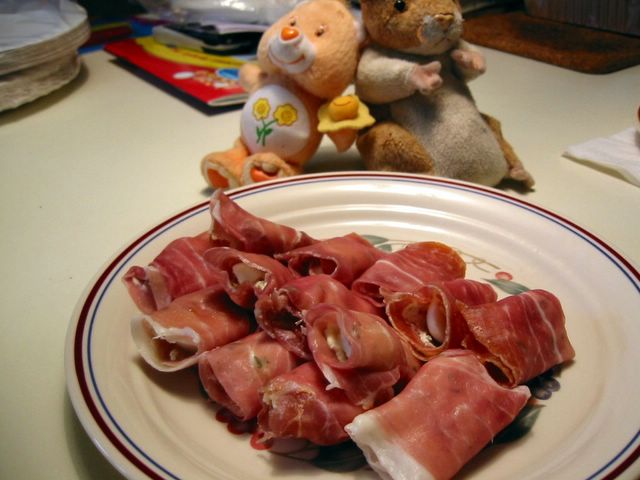
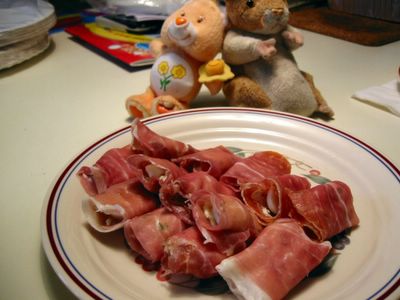 One of the finger foods that I prepared for my aborted participation in the last London Food Blogger's picnic at the Henley Regatta is this scrumptious quail eggs wrapped in prosciutto. Lovely melding of flavours with the spiky tang of the lime zest contrasting with the creamy and a bit salty cream/smoked cheese mixture serving a nice foil to the blandness of the quail eggs while the chewy-citrusy prosciutto completes the melange of flavour. This was a lovely surprise and one that I will definitely make again. Next time I will try it without the smoked cheese or probably choose one that's not too salty.
I love air dried hams such as the Prociutto di Parma or the Spanish Jamon Iberico or Jamon Serrano. They are just so yummy to have very thinly sliced on sandwiches, cheese or just eaten on their own. Steep prices of these is the only thing stopping me from having them all the time.
Prosciutto Quail Egg Rolls
12 quail eggs
40 g cream cheese
2 Tbsp finely grated smoked cheese
1/4 tsp grated lime zest
1 tsp chopped fresh basil
6 slices prosciutto di parma (parma ham)
- Hard boil quail eggs by lowering in a gently simmering pan of water. Cook for 4 minutes. Drain and cool immediately by plunging into cold tap water. Peel and cut in half lengthwise.
- Combine cream cheese, smoked cheese, lime zest, chopped basil in a bowl. Mix well.
- Cut prosciutto in half lengthwise then cut in half again crosswise making 24 pieces.
- Spread cream cheese mixture in each strip then wrap each of the quail egg halves in it. This can be made about 6 hours in advance.
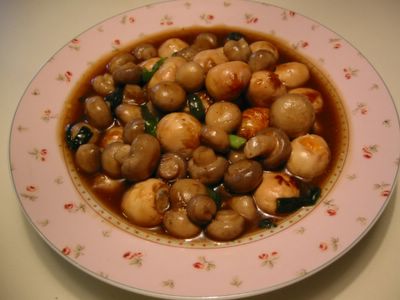
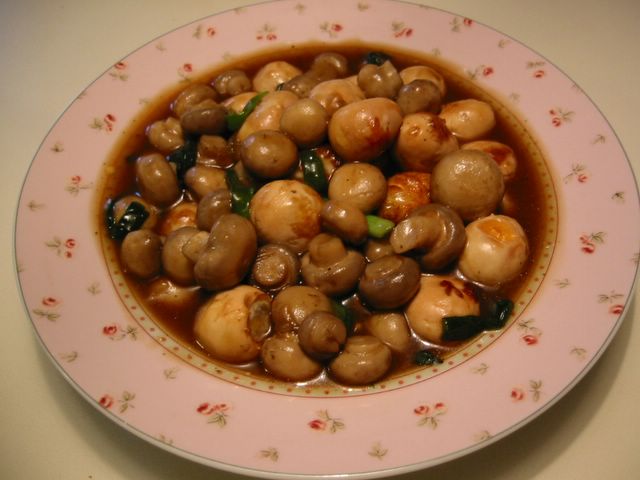
Originally, my entry would have been Leche Flan - the creme caramel version of the Philippines. But decided not to, since I mixed up my aunt's instructions on the recipe with me putting in 2 cans of condensed milk and 1 can evaporated milk instead of the otherway around. Result was a very sweet dense flan, almost like a dulce de leche. Well scrap that, I just have to find a way to use it up. Enter this savoury dish of quail eggs which is quite easy to make. The recipe I adapted from Huang Su-Huei's Chinese Cuisine cookbook was a bit on the salty side so had to reduce the soy sauce and eliminate the salt. Other than that it was quite nice and I love the way the baby button mushrooms and the eggs mimic each other's shape and colour. Can you guess what I forgot in the presentation? I should have put this in a bed of steamed green veggies. But in my haste and excitement I forgot and only remembered when me and my husband began eating it. Being mostly eggs, it was quite rich so it needed the foil of something bland. Also I think it would benefit from being only one of a group of dishes on a lunch/dinner spread. It seems quite rich just on its own.
I'm sure this version of the IMBB would have a lot of participants due to the universality of the theme (which in case you didn't notice is *eggs*). Thanks is in order to Viv of Seattle Bon Vivant who thought up the theme and is hosting this edition.
Braised Quail Eggs with Mushrooms
24 quail eggs
1 Tbsp soy sauce
2 cups oil for deep frying
1 green onion - cut into 1 1/2 inches length
2 cups canned or precooked fresh baby button mushrooms*
*Sauce:
1 1/2 Tbsp soy sauce
1/2 Tbsp cooking wine
1/2 tsp sugar
freshly ground black pepper
1 cup stock
*Thickener:
1 Tbsp cornstarch
1 Tbsp water
- Hard boil the quail eggs by lowering them in a saucepan with gently simmering water. Cook for 5 minutes. Turn off heat. Remove hot water from saucepan and then fill up with cool tap water. Replace water again once it gets warm again. This is to stop the eggs from cooking. Drain eggs from water and cool completely.
- Peel eggs, mix and marinate with the soy sauce for about 15 minutes. Drain.
- Combine all ingredients for sauce and thickener in separate bowls.
- Heat 2 cups oil in a wok or saucepan and deep fry the marinated quail eggs for a few minutes or until golden brown. (Some of the quail eggs may balloon and burst at this point) Remove from oil and drain. Set aside.
- Heat 2 Tbsp oil in the wok and saute green onions until aromatic.
- Add mushrooms and sauce; stir fry for about 2 minutes.
- Stir in quail eggs. Then the thickener. Stir to mix.
- Best to serve on top of steamed or blanched vegetables like broccoli, pak choi, cabbage, etc.
*Note: You can precook mushrooms by cooking or steaming it in simmering water.
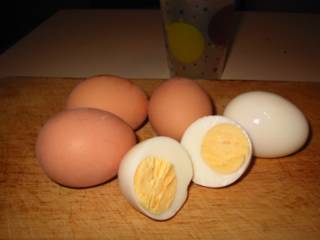
I know, I know, you must have thought this is a no-brainer. Well my children don't know how to do it properly yet so please indulge me in setting their boiling knowledge straight.
Now the thing about hard boiling eggs is not to boil them but to simmer them to minimise the cracking of the shell. Bring them to rolling boil and then turn the heat way low and simmer. Also the choice of eggs is important. You should use eggs that are about a week old. Fresh eggs when hard boiled are quite hard to peel. Other people pierce one end of the eggs I think to make the yolk stay in the centre (I'm not so sure about that). They also should preferably be in room temperature to reduce cracking. The greater temperature changes it goes through in a short span of time the greater the chances of cracking.
To Boil an Egg
* Method 1:
- Put room-temperature eggs in a saucepan and add enough water to cover them.
- Bring to boil. Once it boils, cover (if it is not yet covered) the saucepan. Turn off heat and begin timing.
- For hard-boiled - let stand in saucepan for 10-12 minutes depending on the size of the eggs.
- Drain water from saucepan and fill-up with cold tap water. Keep it submerged for about 5 minutes or until cool enough to handle. Drain cold water and serve boiled eggs hot or cold.
* Method 2:
- Put eggs in a saucepan and add enough tap water to cover them by about 1/2-inch.
- Bring to boil. Once it boils begin your timing; turn down heat to low and simmer.
- For hard boiled - simmer for 10 minutes. Cook for less time if you want the centre more squidgy.
- For soft boiled - simmer between 3 - 5 minutes. The less time you cook the softer the boiled egg will be.
- Remove from saucepan and submerge completely into a container with cold tap water (or drain the hot water from the saucepan and fill it up with cold tap water). Keep it submerged for about 5 minutes draining and refilling again if the water becomes quite hot. This submersion is done to stop the egg from further cooking. If you cooked soft boiled eggs and did not cool it down immediately you could well end up with hard boiled eggs.
* Method 3:
- Keep eggs chilled in the fridge.
- Bring a saucepan with water to a boil (make sure the water is enough to cover the eggs).
- Lower the chilled eggs straight from the fridge. Start timing at this point.
Bring the water to a simmer and cover.
Timings: - 14 minutes - hard boiled
- 12 minutes - hard boiled with a little soft spot centre
- 10 minutes - hard boiled with gooey middle
- 8 minutes - fully set white and yolk with soft gooey middle
- 6 minutes - soft boiled with firm white, yolk starting to set
- 5 minutes - soft boiled with firm white, runny yolk
- 4 minutes - soft boild with very soft white and yolk
I adapted this last method from an Epicurious article with excellent tips as well on how to quickly peel eggs. Apparently, boiling eggs straight from the fridge helps a lot in being able to peel eggs easily.